Sunday, April 19, 2026

The Declaration of Marseille | UMURM - the Universal Masonic Union of the Modern French Rite


The Declaration of Marseille | UMURM - the Universal Masonic Union of the Modern French Rite

Declaration de Marseille

Marseille, April 11, 2026

Barcelona to Marseille: Continuity and Commitment of the Modern Rite

Gathered in Barcelona in June 2011, the Philosophical Bodies of the Modern Rite performed a foundational act by creating the Universal Masonic Union of the Modern Rite (UMURM). This act was not merely organizational; it forcefully affirmed a vision of Freemasonry grounded in absolute freedom of conscience, the sovereign independence of its constituent Bodies, and the determination to make the Modern Rite a living space for dialogue, mutual recognition, and initiatic universality. Barcelona thus established the bedrock, the framework, and the method: to unite without imposing uniformity, to coordinate without dominating, and to gather together without excluding.


Eight years later, in Porto—a city symbolically marked by the history of liberty—the UMURM reaffirmed this orientation, endowing it with both doctrinal and forward-looking significance. The Porto Appeal of 2019 served as a reminder that while direct persecution largely belongs to the past, dogmatism, ideological imperialism, and the temptation to retreat into identity-based isolation remain contemporary realities. In the face of these dynamics, free Freemasonry is called upon to strengthen its capacity for resistance, regeneration, and plurality. Porto underscored that initiatic work is not an abstraction, but a living praxis—that "the work is done in the doing"—pursued in a spirit that is humanist, cosmopolitan, and deeply committed to human dignity.


The Marseille Congress, taking place in April 2026, fits fully within this continuum. It represents neither a fresh start nor a rupture, but rather a stage of maturation. Marseille—a Mediterranean crossroads and a port open to diverse cultures and peoples—naturally embodies the UMURM’s vocation to build bridges. First and foremost, bridges between the Bodies practicing the Modern Rite, in order to strengthen the awareness of a shared lineage founded upon reason, ethics, liberty, and progress. Bridges between Freemasons, transcending territorial, linguistic, and Obediential boundaries. Finally, bridges with other Masonic Rites, in a spirit of attentiveness, mutual respect, and recognition of the diversity of initiatory paths.


Indeed, the UMURM asserts that the Modern Rite—by virtue of its history, its structure, and its values—is uniquely suited to play a role of mediation and dialogue within universal Freemasonry. It does so without hegemonic pretensions, without any desire to impose norms, but rather with the conviction that the plurality of Rites constitutes a source of richness when situated within a shared horizon of freedom of conscience and the pursuit of human self-improvement.


From Barcelona to Porto, and from Porto to Marseille, a single trajectory takes shape: to foster a Freemasonry that remains faithful to its heritage, clear-sighted in the face of the challenges of the contemporary world, and resolutely oriented toward the future. Marseille 2026 thus aims to serve as a time for reflection, convergence, and openness—dedicated to a universal Freemasonry that builds bridges rather than borders.

Thursday, January 23, 2025

The Influence of Freemasonry on Wicca and Paganism

The Square and the Circle: The Influences of Freemasonry on Wicca and Paganism by Payam Nabarz.

I am not in the habit of posting about a book I have not read cover to cover. Further, I am doing so admitting that I have some issues with it thus far. In total fairness and in the desire to meet the demands of full and fair disclosure, this has much more to do with the issues I have with the religious movement(s) of Neopaganism and Wicca. These go back to the time in my youth, from my teens through my 30s, when I was involved in those religions.

While I grew beyond those movements and into others, I fully acknowledge that that is a matter of my own path and not a critique of those religions.

Having said all this, and noting there are approaches in this text that I disagree with, I have to say that I am very pleased to see this text and want to encourage anyone remotely interested in this subject to read this title. I cannot excuse myself for allowing this to go unnoticed by me for nearly a decade. My only excuse is that it has been a hectic decade.

My objections are mostly subjective and will most likely evaporate by the time I finish the book. So, why mention them at all? In part because I have seen masonic authorities behave in very unmasonic ways toward pagans in their midst. This is inexcusable. I want to point out that even when we may have differences, they do not outweigh our need for tolerance and acceptance.

The author clearly has close familiarity with both camps and delves into a detailed and informed comparison of the structural and ritual similarities of the two rites as well as a thoughtful history of their interaction.

While I believe there is room for more work relating to this, I am pleased that Payam Nabarz has offered such a careful introduction to a topic which deserves better understanding. I am certain this book will advance that cause. If I can draw even a couple of new readers to the book or encourage further research, I will be pleased.


A book on the Saints John


I realize it has become traditional to raise the subject of the two Saints John on their feast days, but as much as I love tradition, I also enjoy flaunting it. That may make me a bad mason in some people's eyes, but if it also makes me an interesting one, I'll be content. Regardless, I recently came across this fascinating title and wanted to share a few words about it.

I know it may be trying to push a boulder uphill, but even though they may not be in English, I hope that by exposing an Anglophone Masonic audience to at least a notice about publications in other languages, a taste for exploration may be encouraged.

In any case, here goes.


The Initiatory Festivals of the Two Saint Johns: The ritual doors of the Masonic year

By Jean-Patrick Dubrun


The Masonic tradition has fortunately preserved the commemoration of the festivals of the two Saint Johns. Celebrated during the winter and summer solstices, they punctuate the year and the ritual work of the lodges. The reference to two Christian saints, the Baptist and the Evangelist, should not make us forget what these two festivals owe to the older initiatory traditions, marked by the transmission of the Light and the formulation of the Word. To understand why and how these two special moments of the year that are the two solstices must be ritualized, it is necessary to go back to the thread of the initiatory tradition, which leads in particular to the Roman god Janus, the astrological signs of Cancer and Capricorn, and the principle of the sacralization of time by the rite. The  possession of these traditional keys sheds light on the symbolic figure of the two Johns and makes it clear why their feast consecrates the opening of the ritual doors of the Masonic year. 

Thursday, November 21, 2024

The Ku Klux Klan and Freemasonry in 1920s America

It is rare that I post on books that address troubling aspects of Freemasonry's role in society. There are several reasons for this, none of which include a desire to avoid controversy or to avoid critiquing Freemasonry. The fraternity is a human institution ana as such it is no more above reproach than any other sphere of human experience. Beyond that, no small number of books critical of Freemasonry have historically been of questionable accuracy and of more questionable intent.

This book however, deserves a read. Now more than ever. It must be remembered that even an institution that historically strove to scrutinize its applicants thorough is likely to not always do so well. One that emphasizes familiarity and presumes a level of character can sometimes be blinded. We all know that in the Southern United States, many though not all masons had been involved in the Confederacy, including some of the most influential. 

Not all who enter Freemasonry truly embody Freemasonry's aspirations and values. Unfortunately, some have not only misrepresented themselves to the fraternity but to themselves as well. This book, without intending to besmirch Freemasonry, applies its own standards of honesty and self-reflection to understand and make clear one of Freemasonry's more troubling  moment. It also demonstrates how the fraternity was able to remain faithful in the longue dure to its true principles.


From the publisher's site:


The Second Ku Klux Klan’s success in the 1920s remains one of the order’s most enduring mysteries. Emerging first as a brotherhood dedicated to paying tribute to the original Southern organization of the Reconstruction period, the Second Invisible Empire developed into a mass movement with millions of members that influenced politics and culture throughout the early 1920s. This study explores the nature of fraternities, especially the overlap between the Klan and Freemasonry. Drawing on many previously untouched archival resources, it presents a detailed and nuanced analysis of the development and later decline of the Klan and the complex nature of its relationship with the traditions of American fraternalism.


Table of Contents

Introduction

Chapter 1 – Klanishness: Brotherhood in the Invisible Empire

Chapter 2 – Freemasonry’s Fighting Brother: Militancy, Fraternalism and the Ku Klux Klan, 

Chapter 3 – Kluxing America: The Use and Abuse of the Masonic Reputation

Chapter 4 – Hate At $10 a Package: Selling the Invisible Empire

Chapter 5 – Hooded Freemasons: Dual Membership and Conflict in Local Lodges

Chapter 6 – Dallas Klan No.66 and Anaheim Lodge No.207: A Case Study of Two Communities 

Chapter 7 – Friend or Foe? Grand Masters’ Responses to the Ku Klux Klan

Chapter 8 – The Collapse of the Second K.K.K.

Conclusion - An "Invisible" Empire?


This book may disturb some Freemasons, perhaps it should. The instution of Freemasonry in all its varieties needs be reminded that we are not perfect, but hopefully in the process of becoming better. Part of that work is committing to writing a more accurate and probing history of our craft. And reading it.


See Routledge's page on this book


Sunday, May 19, 2024

Bantu Religious Traditions in Africa and the Americas: a course

Many do not have a clear idea of the roots and character of Bantu spirituality nor the extent of its influence in the Americas. Indeed, many view the terms Bantu and Congo (or Kongo) as synonymous. While they are related, synonymous they are not.


There are many Bantu ethnicities each with their own languages and religions across most of subsaharan Africa. The BaKongo with an important historical kingdom was one of these, and happens to be the one that left a significant mark on African derived religious traditions in the Americas.


While Bantu religions in Africa shared many similarities, they also had significant differences, and thus should not be considered interchangable. Few actually had any significant impact on New World practices.


There are also many speculative attempts to classify their practices. For better or worse, modern attempts claim a scientific character to them, or to Khemeticize them.


After having received requests to do so, I am planning a course to explore many of these themes.


"The King of Congo and the Bantu Roots of Afro-diasporic traditions" will look broadly at the diverse Bantu practices in Africa, from initiations to divination. It will also explore the Congo influences in the Americas from carnivals to spiritual practices. Along the way we will touch on the reasons for C or K in Congo/Kongo, and what that difference is not.


Cost for the course is $250. Email  to register. As with all my classes all lectures and written/graphic materials are delivered asynchronously so that you can participate on your schedule and can review materials often.

Thursday, February 22, 2024

A New Raprochement: The Church and Masonry

Cardinal Calls for Permanent Dialogue with Freemasons


Following a closed-door meeting in Milan, Cardinal Francesco Coccopalmiero reportedly said he believed ‘an evolution in mutual understanding’ had taken place between masonry and the Church over the past 50 years.

https://www.ncregister.com/blog/pentin-cardinal-calls-for-permanent-dialogue-with-freemasons?amp


Tuesday, January 16, 2024

Gender and Transgender in Masonry: Evolution in Advanced Societies

Género y Transgénero en la Masonería: Evolución en sociadades avanzadas.


Gender and transgender in Freemasonry seem to be unrelatable concepts. However, Freemasonry as a social movement that has crossed the barrier of centuries of existence, is not impermeable to changes in society.

It has been able to adapt very well to them, although for archaic mentalities such ideas represent a taboo or red line that should not be crossed much less talked about. LGTBIQ+ groups and feminism have been interrelated with each other, and they have also done so within Freemasonry.

That is what this work is concerned with, demystifying, making visible and self-criticizing the institution from within from a microsociological, constructivist and, why not, deconstructivist perspective of sex and gender relations. It makes visible, through a mixed methodology (quantitative and qualitative that includes statistical analysis and four case studies: France, Spain, Portugal and Ecuador as advanced societies understood as democratic) the formation of behaviors, prejudices, stigmas by which masculinity prevent the humanization and total incorporation of everything feminine, even in the case of trans women.


Género y transgénero en la Masonería parecen conceptos que no se pueden relacionar. Sin embargo, la Masonería como movimiento social que ha traspasado la barrera de los siglos de existencia, no es impermeable a los cambios de la sociedad.

Ha sabido adaptarse muy bien a ellos, aunque para las mentalidades arcaicas sea una especie de tabú o de línea roja de la que no hay que hablar. Los colectivos LGTBIQ+ y el feminismo se han interrelacionado entre sí, y también lo han hecho dentro de la Masonería.

Es de eso que se encarga esta obra, de desmitificar, visibilizar y autocriticar la institución desde adentro bajo una perspectiva microsociológica, constructivista y por qué no, deconstructivista de las relaciones sexo y género. Visibiliza, a través de una metodología mixta (cuantitativa y cualitativa que incluye la estadística prospectiva y cuatro casos de estudio: Francia, España, Portugal y Ecuador como sociedades avanzadas entendidas como delocraticas) la formación de los comportamientos, los prejuicios, los estigmas que desde la masculinidad impiden la humanización y total incorporación de todo lo femenino, inclusive en el caso de las mujeres trans.


On sale in #Spain 🇪🇸 and #Portugal 🇵🇹 at https://www.amazon.es/dp/B0CQGLRB18

For #USA 🇺🇸 and the rest of #LatinAmerica 🇦🇷🇧🇷🇨🇱🇨🇴🇪🇨, on sale through https://www.amazon.com/dp/B0CQGLRB18

For #Canada 🇨🇦 https://www.amazon.ca/dp/B0CQGLRB18

In #France 🇫🇷 via https://www.amazon.fr/dp/B0CQGLRB18

In #Italy 🇮🇹 https://www.amazon.it/dp/B0CQGLRB18

Tuesday, October 17, 2023

The French Rite & The Knights of the Rosicruz in Brazil


Translated from Racó de la Llum: Les·ilusionades passes d'un Francmaçó del Ritu Modern o Francès

O Soberano Grande Capítulo dos Cavaleiros Rosacruzes. Grande Capítulo Geral do Rito Francês de Portugal ~ The Sovereign Grand Chapter of the Rosicrucian Knights. Grand General Chapter of the French Rite of Portugal

This entry is a brief historical exposition about a significant Masonic Power in the practice of the Orders of Wisdom at the world level, and in which I have the immense pleasure of being an Honorary Member: Soberano Grande Capítulo de Cavaleiros Rosa-Cruz / Grande Capítulo Geral do Rito Francês de Portugal.

The constitution of Masonic Lodges in Portugal seems to date back to 1727 , and it was the result of English and Scottish military and merchants as well as French ones also dedicated to trade in these countries. Hipólito Costa played an important role in the development of Portuguese masonry at the beginning of the 19th century is fundamental because of the intense persecution by the well-known Inquisition throughout the peninsula. The adventures and journeys of this historical personage as well as other details of the historical context that we will not discuss in this article, although we assume that he was responsible for the French Rite, whose rituals were published and printed in 1801, becoming the official rite of the first Gran Oriente Lusitano.


The foundation of the Gran Oriente Lusitano dates from 1802. Two years later, on April 25, 1804 , a Treaty of Friendship was signed with the Grand Orient of France (where the grade of Caballero Rosa-Cruz appeared among the Portuguese masons who signed it, showing its pre-existence on that date, probably since 1802).


Through this Treaty between the GOL and the GODF, the existence and functioning of the Orders of Wisdom of the French Rite in Portugal has been accredited, at least since 1804, the year in which an official patent will be issued. On the other hand, the Constitución del Gran Oriente Lusitano de 1806 refers explicitly to the different orders and chapters of the French Rite, in its chapter III and article XIII , which presupposes the existence of a "Sovereign Grand Chapter of Caballeros Rosa Cruz" , among other chapters.

While in France for other reasons, the Orders of Wisdom ceased to be practiced for about 170 years (approximately from 1830 to 1999) in Portugal , fortunately the work of the Sovereign Grand Chapter of Caballeros Rosa-Cruz , continued during this long period, despite the numerous persecutions and prohibitions of those who were the target of Freemasonry. It was worked uninterruptedly from 1804 to 1939 , that is, around 140 years . After Salazar banned Freemasonry in 1935, in a totally underground manner, the last survivors of the "Sovereign Grand Chapter of Caballeros Rosa-Cruz" were incorporated into the Supreme Council of Grand Inspectors Generals of the 33rd Degree of the Ancient Scottish Rite and Accepted for Portugal. its jurisdiction, through the Agreement of 1939 and, as of this date, the French Rite or Moderno is no longer practiced in Portugal.

Only in 1991, after the Claves Revolution of April 25, 1974, with the foundation of the "Delta" Symbolic Lodge, the French Rite was reintroduced in the Grande Oriente Lusitano, which was practiced for 10 years exclusively by this Lodge. Since 2001, an important group of freemasons from the Lusitano Grand Oriente, belonging to the Respectable Lodge "Delta" and the Spanish brothers of the Iberian Grande Oriente (GOI) were raised in France, under the auspices of the Latin American Grand Oriente (GOLA) in a gradual manner and successively in the different Orders of Wisdom of the French Rite, with the support of the Brothers of the Grand General Chapter of the Great East of France .

This initial spark finally resulted in the creation of the "Grand General Chapter of the French Rite of Portugal" with a patent granted by the GOLA who in turn had received it from the Godf on December 20, 2000.

The Supreme Council of the Ancient and Accepted Scottish Rite , depositary since the Agreement of 1939, of the Patent and of all the powers of the jurisdiction and the administration of the French Rite for Portugal, reactivated in 2003, the Sovereign Grand Chapter of Caballeros Rosa - Cruz , with raised masons in France, as well as with others, especially MM II II HH Fernando Valle and Emídio Guerreiro, initiated in the French Rite 80 years ago , the last survivors from 1939 at the age of 103 and 104 respectively in 2003 , transferring to This Sovereign Grand Chapter the Patent and all its prerogatives, thus allowing the restoration of the Chain of Union of the French Rite in Portugal, in all its fullness, without interruption, and that its reactivation in 2003, with the presence of the Venerable Brothers Fernando Valle and Emídio Guerreiro, aged 103 and 104, implied that the Chain of Initiatic Union of the French Rite and its Orders of Wisdom since 1804 until 2003 has been practiced for at least 200 years. These masons, convened by brother Fernando Valle on August 27, 2003 , decided by unanimity in the Assembly on September 5, 2003, in the Masonic Palace of Lisbon, the integration of these two organisms into a unique Masonic Power, Free and Sovereign, with the aim of preserving the historical legacy and tradition of the French Rite in Portugal, thus constituting the Sovereign Grand Chapter of Caballeros Rosa-Cruz - Grand General Chapter of the French Rite of Portugal.

Joaquim Villalta, Vª Orden, Gr.·. 9, 33º

Director of the  International Academy of the Vª Order - UMURM

Grand Orator of the  Sublime Council of the Modern Rite for Ecuador

Honorary Member of the Sovereign Grande Chapter of Cavaleiros Rosa-Cruz de Portugal 

Honorary member of the R. L.·. Estrela do Norte nº 553 of the Grand Oriente Lusitano

Grand Chancellor for Europe of the Grand Oriente Nacional Colombiano

Honorary Member of the Grand Oriente Tradicional de Bolivia

Honorary Member of the  Supreme Council of the 33º and Ultimo Grado del RSAA per l'Italia e sue Dipendenze

President of the International Confederation of Supreme Councils of the 33º Degree of R.·. E.·. A. A.

Muy Poderoso Soberano Gran Comendador del  Supremo Consejo del Grado 33º para España del Rito Antiguo y Aceptado (Rite de Cerneau / Thompson-Folger Supreme Council for The United States of America, their Territories and Dependencies)


Friday, October 6, 2023

French or Modern Rite: Foundational Rite

The original lack of distinction between historical fact and legend embodied in the first Masonic documents has remained in force for many Freemasons despite the passing of the centuries. Much of this “deformation” was the responsibility of Anderson himself when he attempted to “legitimize” the new obedience structure in the Constitutions of 1723 with a History of Freemasonry that dates back from Adam to that date at the beginning of the 18th century.

Freemasonry, our Freemasonry, is a traditional and symbolic initiatory Order that is only an indirect heir of those builders of cathedrals. Contemporary Freemasonry was born at the end of the 17th century and beginning of the 18th century, (borrowed from earlier Scottish practices) around the Royal Society in a country that emerged from horrible religious wars. These men of science and enlightenment who do not want to give up their spiritual aspirations are inspired by the rites and symbols of these cathedral builders of whom they are not direct heirs, creating a modern speculative Freemasonry based on myths imported for this purpose. Be that as it may, what is unquestionable is how its evolution was and should be simple and straightforward. A clear symbolic-allegorical use that ultimately should show a close and simple message. A content that stimulates man's potential through moral orthopraxis, appreciates his freedom as well as the use of it; finding that happiness in the self-critical search for shared perennial responses with a sense of belonging and universal interaction and awakening responsibility towards a whole - humanity - freed from all types of irrational or subjugating imposition.

Speaking of "our Freemasonry", we admire its methodology that aims to unite the dispersed and free itself from the discriminatory yoke, giving entry to every human being, regardless of their religion and political ideology. This universal and ecumenical spirit was the trigger for the idea of ​​Désaguliers and its environment, being able to accommodate every human being with fundamental ethical-moral principles, keeping them sheltered from the forces of tension generated by religious diversity, always source of confrontations, as well as political dissent outside the Lodge. In this regard, it is curious to see how this contention in political and religious opinion,

The organizational structure of Freemasonry as we understand it today therefore comes from the Grand Lodge of London (though the ritual origins are Scottish) and the entire environment that gave rise to its genesis, despite other fanciful theses without historical and masonological foundation.

Without a doubt, the Freemasonry that developed the Ancient Duties since 1390 was a Christian professional corporation of a religious type. First Catholic until becoming Protestant (when reconstituted in London). The essentially biblical content of this operative Freemasonry attests to this. However, over the centuries, Freemasonry underwent various metamorphoses that, diversifying its primitive identity, ended up making this ancient Christian professional corporation a modern expression of the tradition of eclecticism.

Around 1637, Scottish Freemasonry, developed the Mason Word rite that contributed to transforming the old operative Freemasonry into speculative Freemasonry.

In 1723, Désaguliers and Anderson presented as the moral basis of the Order the natural religion that became in that speculative environment a consistent door to open philosophical thought and various forms of deism and even theoretical atheism, and of course freethought in the lodges. The successive penetration of these diverse points of view in Freemasonry, in addition to explaining the genesis of eclecticism, should invite us to reflect on the consequences and peaceful coexistence of said diverse points of view within the same Masonic Order.

The rite of the Mason Word, created around 1628/1637 by the Scottish Freemasons of Kilwinning to replace the operative Ancient Duties rite of the Middle Ages and Renaissance, was Anglicized and Catholicized in being transmuted by the Grand Lodge of London of 1717 into a universal philosophical rite. And this is where the true greatness of this ecumenical principle lies, which, among other ritual forms, the Modern or French Rite, for example, has been faithful despite the passage of time and history.

In its natural expression, Freemasonry, consistent and heir of this enlightened approach, tends and must tend towards that non-exclusive universality, not restricted to criteria of a particular internal order, religious, formal or discriminatory, from respect and tolerance, uniting from diversity where the common link is the practice and development of virtue, making good prevail over evil.

It is the Insular, that is, Scots, Irish, and even English who install Freemasonry in France. Their motivation is not the desire to transmit Freemasonry in France, but rather that they have been forced to flee England due to the dynastic and religious conflict that occurred at that time, and this is what makes most of them Jacobites, for about forty years, did not stop coming and going through the English Channel with their rituals in use, particularly from the Grand Lodge of London and Westminster, created in 1717, as occurs with the “Modern” affiliation ” referred to Belgium, a country with lodges established since 1721, or Holland somewhat later.

Christianity of a confessional and religious type was resumed in France in 1735 when, translating the “Duties of a Freemason” inserted by Désaguliers in the Constitutions of 1723, Abbot Moret, grand secretary of the Grand Lodge in France, Christianized Désaguliers' text, whose version dated 1737 served as the constitution for the first lodges in Sweden, later converted into confessional lodges. This act in said geographical context was undoubtedly due to the historical-social reality whose days were numbered.

It cannot therefore show any contradiction when the rite of the Moderns resumes during the continental Enlightenment that leads to the “Régulateur du Maçon” its base form proposed by Désaguliers, through demanding the simple duty of the spontaneous practice of the universal moral law. inscribed in the heart of every human being and in every era. This personal attitude does not include, but does not exclude, the institution of communities such as Churches. But the community does not become a social group instituted by the churches, but by natural communities, whether family, friends, the non-denominational (secular) State and from there all humanity.

The secular State is not deprived of ethical or spiritual values. This liberal secular state is inevitably a consequence of confessional pluralism, a place of cultural mixing and in particular of religious values.

Humanity constitutes a community, a unity that cannot exist without practical respect for ethics, for love of neighbor.

The Rite of the so-called “Modern” is translated into French and is practiced by almost all of the lodges that are created in the kingdom and does not seem to have a name. It is simply Freemasonry. A Freemasonry that inherits some of the oldest Masonic traditions, which is not fixed word by word, although for administrative reasons, tends more and more to write it down, but which has a fundamental symbolic structure.

The appearance of these other Masonic systems, almost always "Scottish", where the name has no real relationship with its true place of origin, and closely linked to the proliferation of the so-called High Degrees above the Third Symbolic Degree, makes the The Grand Orient of France's efforts to organize and control French Freemasonry, and the desire of numerous lodges to have a universal version of the rituals, are the cause of the establishment of a "Modern" rite between 1783-1786, a Regulation of reference, which has its advantages and disadvantages that we will address on another occasion, and which in the future will be known by the name “French”. For the High Degrees, This analogous work will be carried out within the Grand General Chapter of France founded in 1784 and later linked to said Obedience in 1786, adding four higher orders plus a Fifth Order of an academic and administrative nature: Secret Elect, Scottish Grand Elect, Knight of the East and Sovereign Prince Rose-Croix, plus a Fifth Order. On this question, Pierre Mollier points out in his contribution to the Introduction of the book dedicated to the rituals of the Sovereign Metropolitan Chapter of 1786: Let us emphasize, however, that it would be a mistake to consider the Grand General Chapter of France as the Author of the French Rite. This assembly of learned Masons only fixed its use by retaining the more traditional high degrees in their more sober versions. Thus, twenty years before the creation of the Grand Chapter, a system very close to the one that the French Rite will take was already practiced. In the 1760s, the Scottish Mother Lodge of Marseilles. Even previously, this desire for ordination and reduction in High Degree Freemasonry is confirmed in the porous Franco-Belgian relationship and interaction. Let us remember that Modern Freemasonry was established through various means in those East, either directly via London or via France through the Grand Lodge directed by the Count of Clermont. In this way the Marquis de Gages (whose lodge “La vraie et parfaite harmonie” of Mons is from the correspondence of the GLdF) appears appointed by Louis de Bourbon in 1766 as « Grand Maître provincial et Inspecteur Général des loges rouges et bleues pour les provinces of Flanders, Brabant and Hainaut. Taking advantage of the situation and difficulties that French Freemasonry is going through and the distancing that this entails between Gages' connection with the GLF, the intended grouping of zonal lodges emanating directly from the GL of London will lead, among other very curious cases, to the creation under London's patent of an authentic and seriously structured "Belgian" obedience, having the Marquis of Gages as provincial Grand Master: the provincial Grand Lodge of the Austrian Netherlands, which will regulate that certain reigning disorder (specifically regarding decentralization ) and will bring together the Lodges in its surroundings. As we pointed out, through the letters between the Count of Clermont and the Marquis de Gages, the former expresses the work of structuring him into 15 degrees in 1767. According to Adolphe Cordier, of the rituals written by the Provincial Grand Lodge of the Austrian Netherlands that greatly exceeded twenty, finally the Degrees were reduced to fifteen in 1776. In this line, it is worth highlighting that already in 1772, it is the Marquis of Gages who externalizes his project of a Masonry in 7 Degrees to the Venerable of the Lodge of Alost within a context of containment in the receptions of Degrees, indicating that some could become useless in the future if they are conferred. It is precisely in a structure in three Degrees and Four Orders, plus a Fifth Order that contains all the Physical and metaphysical Degrees and all the Systems/Rites, that the Grand General Chapter of France of 1784 elaborates. In 1786 the Grand Orient of France proposes a reference text for the three blue degrees, distributed in the form of handwritten copies,

On the continuity of the Modern Rite in Seven Degrees in the Netherlands also called in those Valleys by the names of Scottish Reformed and even Old Reformed since they considered the structuring of 1784 as a “reform” of the Scottish, or Ancient degrees (by antiquity , not because he is of descent from the Antiens), we must point out some transcendental questions that we will address in extensive in some upcoming works that we will direct for those of us who seek (or so we try) to know certain truths through historical study and follow-up.

This is:

a) The creation in 1803 of the Hoofdkapittel der Hoge Graden in Nederland (Supreme Chapter of the High Degrees) in Holland by Independent Chapters following a system of Degrees created by analogy to that of the Grand Chapitre Général de France, although the origin and type of its rituals are of another origin (a surprise element still unknown to many).

b) In Belgian lands, and following the tradition that proliferated in the southern Netherlands during the 18th century, what we know today as Chapters, develop freely and sovereignly as an extension of a Blue Lodge to whom they correspond and are linked, also being called the Sovereign Chapters. as Grand Atelier (Great Workshop). After the French withdrawal, the pre-existing chapters and those created during the occupation maintained, after the occupation, this organizational procedure, outside of any Chamber of Administration belonging to a Grand Chapter or Obedience (see archives of the R.•. L.• of Hope in the East of Brussels or of the Philanthropic Friends of that same Or.•.).

c) This working procedure in Independent and Sovereign Chapters is also taken up in connection with the creation of the Sovereign College of the Scottish Rite for Belgium (still in force today) following the rejection of the hierarchical structure of the Supreme Council of the REAA in 1962, which which did not represent any organizational novelty in the Masonic history of that country and which brought together several of the most historical Chapters and Areopagus, imposing itself on the current of Liberal Freemasonry in those East.

In the 19th century, the Modern Rite became the equivalent of the French Rite. That is why Vuillaume uses the two terms, since it applies to both the first three degrees and the higher orders. This term French Rite will prevail while that of Modern Rite falls into disuse in the last third of the 19th century. Let us keep in mind, however, that in Belgium, linguistic and national problems did not impose the adjective “French”, and the adjective “Modern” was always used. In any case, throughout the 19th century the differentiation between the French Regime and the Scottish Regime will grow. In 1858, a new wording was published for the symbolic degrees of the French Rite called Murat, who was Grand Master. “Ideologically”, the text is hardly different from the Régulateur. The new model continues to define Freemasonry in a “classical” way. After the Convent of 1877 its resolutions led to more daring adjustments and it was when in 1879, the Grand College of Rites commissioned by the Council of the Order of the Grand Orient of France made the apparently religious formulas disappear from the rituals, such as the reference to Great Architect of the Universe, which the Grand Orient of Belgium had already abolished its obligation in 1872. In 1886, a commission of 12 members, chaired by the lawyer Louis Amiable (1837-1897), proceeded to a new review. The new French ritual will take the name of its main editor, and is accompanied by a “report on the new rituals for the lodges” written by Amiable himself. This explains that the new text, partly inspired by the rituals of the Great East of Belgium, They largely refer to positivism. Its general philosophy is that of “neutrality between different beliefs” and the fact that “the evident data provided by the current state of science had to be taken advantage of.” During this half century, the practice of all orders of wisdom fell into disrepair. disuse on the European continent. The Amiable ritual, somewhat modified in 1907 under the authority of the Grand Commander Juan-Bautista Blatin, will remain in these conditions until 1938, date on which the initiative of Arthur Groussier, then Grand Master of the GOdF adopts a new model of the French Rite. The new version is an attempt to return to the symbolic sources of the French system, and not a new, even more ultra-positivist grind. In 1955, the definitive version of the Groussier ritual was disseminated, slightly arranged in the form and under the authority of Paul Chevalier, it is printed and distributed. In the long work of reconstructing obediences in the postwar period, learned Masons returned to initiatory or symbolic research, wishing to find or revive the potential of the French Masonic tradition of the 18th century, inherited from the Moderns.

In Portugal, the practice of the Modern Rite has been present since 1802. While in France for other reasons worthy of in-depth analysis, the Orders of Wisdom stopped being practiced for about 170 years (approximately from 1830 to 1999) in Portugal, for its On the other hand, the work of the Sovereign Grand Chapter of Knights Rosicrucian continued during this long period, despite the numerous persecutions and prohibitions of which Freemasonry was the target, working uninterruptedly from 1804 to 1939, that is, around 140 years. After Salazar banned Freemasonry in 1935, in a completely underground manner, the last survivors of the "Sovereign Grand Chapter of Rosicrucian Knights, They joined the Supreme Council of Grand Inspectors General of the 33rd Degree of the Ancient and Accepted Scottish Rite for Portugal and its jurisdiction, through the 1939 Agreement and, from this date, the French or Modern Rite ceased to be practiced in Portugal. The reactivation again in all its Orders dates back to 2003 thanks to the Sovereign Grand Chapter of Knights Rose-Cross -- General Grand Chapter of the French Rite of Portugal.

The Modern or French Rite in Brazil requires a special mention given that the Supreme Council of the Modern Rite located in this country is the oldest Philosophical Power of the French or Modern Rite in the world in terms of the uninterrupted practice of all the Orders. of Wisdom and unique in maintaining his legacy until the “European revival” of the late 90s, working with the Mother Rite in those East since 1822, and which gives him the unquestionable status of Chef d'Ordre.

Regarding the Régulateur du Maçon, although it should not be considered the source of the French or Modern Rite, it aims to historically establish itself as a unique model, collating and unifying the previous oral and manuscript traditions for the symbolic degrees, after a period of certain disorder in which Freemasonry suffered from an insufficiency in the central organization, whose absence of ritual unity gave rise to apocryphal excesses in most cases, whose replica of containment for the so-called High Degrees is reflected in the Régulateur des Chevaliers Maçons that we will address in the near future. .

The peculiarity of the Masonic ritual of the Modern or French Rite is that it is based mainly on the universality, the visible elements of light (the Sun and the Moon are two of the three great lights), without referring directly to a divine power. Man is thus the center of the mysteries of nature and tries to understand the signs through the study of the symbols that surround him. Belief in God is not excluded, but it remains within the personal scope of the Brothers and Sisters.·., to live this understanding of nature, leaving others full freedom in the search for truth, away from all dogma or imposition, whatever the type.

The Ritual form of the “Régulateur du Maçon” demonstrates its timelessness through its full symbolic richness and the validity of its structured message where tradition and modernity coexist.

The French Rite is essentially mythical. It conveys three fundamental myths:
The myth of the passage from darkness to light
The myth of the construction of Solomon's temple
The Hiram myth.
Let us not try to find in it:

Nor the religious thought that implies a total submission to an absolute reality. The Modern or French Rite does not contain anything religious or "sacred", nor prayer, nor any act related to a certain confessional character.

Nor esoteric thought understood as a revelation transmitted to only a select few. This tendency, which can become sectarian, introduces a sieve between the brothers that separates between the elect and the damned, a thought that goes against the universalism of Freemasonry. The Modern or French Rite advocates universalism and the possibility for every human being to develop their potential.

Nor the mystical thought that seeks a total immersion of the individual in what surpasses him. Masonic mythology is based on the idea of ​​a Construction project; deals with the here and now; It places Man at the center of the universe, where he is both material and worker of his inner Temple, but of necessary universal projection and responsible shared exteriorization.

Whatever the ritual form used, the Modern or French Rite, if it pays attention to its original characteristics, imposes itself, today as tomorrow, as an orderly and complete expression of the "permanent" Masonic values: the search for truth, perfectibility For anyone who wants to progress, the liberation to allow the advancement of women and men committed as a link in the social chain.

Plan of the French Rite Lodge
and Distribution of Officers

Postscript:
Fundamental symbolic structures of the French or Modern Rite

Three candelabra arranged NE, SE, SW
Represent the Three Great Lights: Sun, Moon, Master of the Lodge

The Pillars of the Lodge: Wisdom, Strength and Beauty

Beauty and Strength coincide with Columns J and B, and Wisdom is found in an Imaginary column located in the East, in the place of the Venerable.
That is why these Pillars are directly linked to the Venerable and the two Wardens.

The J and B order of the words and the arrangement of the columns according to the Grand Lodge of London.
Mobile jewelry
The Squadron carried by the Most Venerable. The Level carried by the First Watchman and the Perpendicular or Plumb line carried by the Second Watchman.

still jewels
The Scribing Plate, the Pointed Cubic Stone and the Rough Stone.

Lodge Furniture
The Book (or Regulations), the Compass and the Gavel.

Contrasted ritual material:
Disclosure 1724 
Prichard 1730
Prichard 1730 (in Spanish)
Berne 1740
Le Parfait Maçon 1744
Luquet ca. 1745
Le Sceau Rompu 1745
Le Maçon Démasqué 1751
Three Distinct Knocks "Lecture" ca. 1760
Marquis de Gages 1763
Le Corps Complet de maçonnerie RGL de France ca. 1765
Régulateur du Maçon manuscripts of 1783 and 1786
Duc de Chartres 1784
Collection of Précieux 1785
Published edition of the Régulateur du Maçon 1801
Vocabulaire des Francs-Maçons 1810 (Bazot)
Necessaire Maçonnique 1812
Manuel du Franc-Maçon 1817
Manuel Maçonnique 1820
Le Tuileur-Expert 1828

(Compendium of various analyzes and research by Brother Pierre Noël)


Joaquim Villalta, Vª Order, Gr.·. 9, 33rd
M.·. YO.·.
Director of the  International Academy of the Fifth Order - UMURM
Grand Orator of the  Sublime Council of the Modern Rite for Ecuador
Honorary Member of the Sovereign Great Chapter of Rosicrucian Cavaleiros of Portugal - General Grand Chapter of the Modern and French Rite of Portugal
Honorary Member of the R.·. L.·. Estrela do Norte nº 553 of the Lusitano Grande Oriente
Grand Chancellor for Europe of the Colombian National Grand Oriente
Honorary Member of the Traditional Grand Oriente of Bolivia
Honorary Member of the Supreme Sovereign Council of the 33rd Degree for Scottishness of the Republic of Ecuador
Honorary Member of the  Supreme Consiglio of the 33rd ed Ultimo Degree of the RSAA per l'Italia e sue Dipendenze
Member of the Suprême Conseil du 33e Degré pour la France du Rite Ancien et Accepté (Cerneau's Rite)
President of the  International Confederation of Supreme Councils of the 33rd Degree of the R.·. AND.·. TO.·. TO.·.
Very Powerful Sovereign Grand Commander of the  Supreme Council of the 33rd Degree for Spain of the Ancient and Accepted Rite

Thursday, October 5, 2023

Masonic Stones: Etched Ashlars

 The Hedge Mason (Eoghan Ballard) can create etchings on slate, wood, leather, and plastic. I like making veves, firmas, pontos riscados, and masonic designs, but can produce pretty much anything you want. I'll offer a quote based upon the design, material, and size. Email me at eoghan.ballard@gmail.com . I can also produce multiples of any design.


Tuesday, October 3, 2023

The Doubting Mason


Every so often a Masonic book comes along that catches my attention. One such title just made itself known to me. I generally do not warm to books that fit the genre that offers daily or in this case weekly Wisdom. Books that purport to offer a gem a day usually lose me by day two. This book is different. First of all, it doesn't really offer "a gem a day" and as the title suggests it offers doubt.  WEEKLY MASONIC DOUBTS: A pocket companion of squarely critical ponderings for the 21st century by István Horváth is well worth your time.

 To begin with, in the beginning of the book he offers two quotes. The second of them is what told me before the book even began that this was going to be a good read. 

"Let Masonry use the pen and the printing-press in the free State against the Demagogue; in the Despotism against the Tyrant." - Albert Pike


That is a very relevent observation today,

Brother Horváth manages to cut through the usual noise to pinpoint some very significant if obvious truths which most masons tend to ignore. One of these truths is that there are multiple Freemasonries in the world rather than one. He also notes that it should give us pause for thought that an institution that prides itself as being the most tolerant fraternity in the world cannot get the two major branches of their institution to talk to each other and respect each other.

This book is in part about looking at ourselves as masons, warts and all. Go read it.

Friday, January 27, 2023

CROSSING INTO SPIRIT

CROSSING INTO SPIRIT: A  Bootcamp for Espiritismo Cruzado


In a little over 1 week I will be beginning another four week mini-course on Espiritismo Cruzado. This hasn't been offered in over a year and is not likely going to be repeated anytime soon. There are no prerequisites for taking the course. 


Unlike other materials on the subject, this course offers both history and practice.

The classes will be in a lecture format and available online. There will also be a chat feature that will allow for discussion during the month (asynchronously). The course will consist of four one hour lectures, as follows:


1 - History. This will be an indepth history of the antecedents and developnent of Cuban Popular Espiritismo Cruzado, it's relation to other espiritismos and other religions.


2 - The detailed Structure and Pantheon of Espiritismo Cruzado.


3 - The basics of setting up an altar and how to attend to it, and it's spirits.


4 - Development and Study. A discussion of how one approaches spiritual development and practice within Espiritismo Cruzado.


The entire course will cost $300. Pm me in messengea for specific details or email me at eoghan.ballard@gmail.com . But don't delay.


Saturday, December 25, 2021

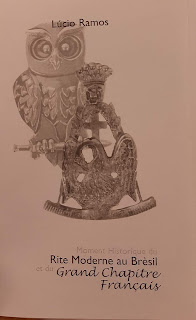
A Rare Text in the History of the French Rite

A communication shared by Q.'. H.'. Joaquim Villalta:

 
I present this rarity edited in 2002 and currently out of print, of which the Academy of the V Order of the Universal Masonic Union of the Modern Rite has a copy as well as a digitized copy. This work is of great value for the documentation that it contributes in the process of re-founding the French Rite in the French "regular" Freemasonry in all its degrees thanks to the transmission received from the Supreme Council of Modern Rite of Brazil, and the exposition of said trajectory from the time of Girard to the transmission of the V Order in the time of Onías Neto, with its mutations, dissensions and events of all kinds. An essential book for scholars of the Modern French Rite.


Acerco este incunable editado en 2002 y fuera de venta actualmente, del que la Academia de la V Orden de la Unión Masónica Universal del Rito Moderno posee un ejemplar así como copia digitalizada. Esta obra es de gran valor por los documentos que aporta en el proceso de refundación del Rito Francés en la masonería "regular" francesa en todos sus grados merced a la transmisión recibida del Supremo Conselho do Rito Moderno del Brasil, y la exposición de dicha trayectoria desde la época de Girard hasta la transmisión de la V Orden en la época de Onías Neto, con sus mutaciones, disensos y eventos de todo tipo. Un libro imprescindible para estudiosos del Rito Francés de los Modernos.

Sunday, July 25, 2021

Kelly Ranasinghe: On Masonic Diversity

As someone who participates in many Masonic groups online and on Facebook, I have on occasion asked myself why. The answer is that on occasion one meets an outstanding Brother whose insight renews both optimism and enthusiasm. One such Brother is Kelly Ranasinghe, of El Centro, California. He wrote a post that deserves to be shared and taken to heart. In fact, although specific to Freemasonry, the advice he offers is applicable to all areas of human interaction. Thank you, Brother Ranasinghe.


Kelly Ranasinghe is a Mason from California and past master of Imperial Valley Lodge 390. He currently serves as the Senior Warden of that Lodge. He was raised in San Diego Lodge 35 in 2010.


"Hey brothers, we need to talk about some racism and microaggressions against Masons of color and Masons who are not from western countries. We are all brothers here, but we may want to keep in mind:

1) Ritual is NOT the same everywhere and neither are obligations, degrees, ceremonies, and literally every other aspect of Masonry. Your Masonic experience is not indicative of everyone's experience, and the American Masonic experience is not universal. For example here in the Southwest, we sometimes do our rituals outside. Just across the border, our sister lodge in Mexicali has entirely different ritual more akin to a Commandery or appendant order. A few miles down the road in Yuma, people wear their aprons differently. All that happens within a few miles of us, so imagine what it is like when the distance is far greater.

2) English is not the lingua franca (pun intended) of Masonry or the world. In fact, it's tied with Mandarin for the most populous language with Hindi and Spanish coming in second. Remember that Brothers may be using English as a second language and be respectful. The way you speak and communicate in your jurisdiction may be socially and culturally different from other jurisdictions.

3) Telling people to "remember their obligation" when the basis of their offense is entirely subjective is called "gatekeeping" but not in the Masonic sense. Gatekeeping is bad. It is when you limit who can and cannot be part of a community or identity based on subjective and arbitrary rules, which often are racist, sexist, elitist, ableist, colorist or other similarly bad subjective judgment calls. Gatekeeping exists in every community, but should not exist in Masonry among people who are Masons. Said another way, it's a way of saying "you don't belong here."

4) Finally, remember that the way you act cordially and friendly is ENTIRELY different based on where you are, your age, your region, your job, and a hundred other dimensions of your identity and subcultures. A Mason in Virginia or Massachusetts is going to speak and communicate differently than me, who lives in the rural border community of South-eastern California. That's the beauty of Masonry, we pull together people who are from entirely different areas for common purposes.

So please, remember we are all walking a very long road to the East, and we ALL can use help to carry the load.

Peace brothers "

Wednesday, June 23, 2021

2nd Anniversary of the Letter of Porto

 JUNE 23, 2021

Second Anniversary of the "Letter of Porto" and of the 2nd International Academic Congress of the Modern Rite / French Rite

Today is the Second Anniversary of the preparation and signing of the "Letter of Porto" emanating from the 2nd International Academic Congress of Modern Rite - French Rite held on June 21, 22 and 23, 2019 with the logistical collaboration of the Sovereign Grand Chapter of Cavaleiros Rosa-Cruz of Portugal and of the UMURM (International Masonic Union of the Modern Rite) being open to all Masonic Powers.

This event was warmly welcomed by the Host and Co-Director of the Congress, the Very Illustrious Brother Belmiro de Sousa, Very Wise and Perfect Grand Venerable of the Sovereign Grand Chapter of Cavaleiros Rosa-Cruz of Portugal. Said act counted as Director of the Congress with Brother Joaquim Villalta (President of the International Academy of the Vª Order) and as Academic Director with Brother Víctor Guerra (President of the Circle of Studies of the Modern and French Rite “Roëttiers de Montaleau”), who were in charge of declaring it open, held at the Losófona University of Porto.

The congress had some extraordinary quality presentations covering such diverse fields, but at the same time intertwined, such as the historical, the symbolic, the sociological and obviously the reflective one on the evolution and prospective of the Modern Rite - French Rite whose values ​​remain in full force 21st century and that must be at the height of a free society tending to an ethical, moral, egalitarian and respectful improvement with the future of all humanity. Likewise, we had the pleasure of enjoying artistic musical interpretations, which interludes of pure gold, in charge of first-rate lyrical voices, reflected a careful organization in detail.

The presence of Illustrious Brothers and Sisters such as Jean-Pierre Duhal, Luigi Sorrento, Antonio Fonseca, Fabrizio Frigerio, Claudie Sorrento, Eric Decanis, Belmiro de Sousa, Rui Alburqueque, Olga Vallejo and Víctor Guerra, among other of the most relevant referential personalities of the French Rite / Modern Rite worldwide made their exhibitions and interventions of the highest level highly valued by some attendees who prevailed the reigning Masonic quality.

The Letter of Porto 2019 signed as the culmination of this Congress of Modern Rite - French Rite by members of the Vth Order from different countries and Masonic Powers, to which other Very Illustrious Brothers adhered whose physical presence was not possible for various reasons beyond their control. will, brings together the essence and the procedural framework that is still in full force. We remember with great gratitude the welcome of the hosts, the historical Sovereign Grand Chapter of Cavaleiros Rosa-Cruz of Portugal, of 1804, who appointed some of us Honorary Members of their Masonic Power, which flooded us with a feeling of infinite joy and healthy pride, aware that the Modern Rite - French Rite is very much alive and present in various continents, committed to working as a Union Center and a model of Liberty, Equality and Fraternity, since it is the Universal heritage and property of all the Masonic faithful to the highest values ​​of the Order, above acronyms, cases or crude messianic attitudes that claim to be the sole guarantors.


This rich Masonic experience and experience of ethical-moral and intellectual growth, despite the pandemic that has hit the planet, generated an unstoppable push of constructive synergies, which has led us to successfully probe different methods of progress and interaction, and that It has given fruitful results on the Masonological level, and relational at all levels. With absolute certainty, we will soon begin to design and coordinate all the procedures leading up to our next meeting since the values ​​of the aforementioned "Charter of Porto" remain intact and its content is a radiant beacon and an example to be followed by its universal values ​​that all of us seek to emulate.


Joaquim Villalta, Vª Orden, Gr. ·. 9.
Director of the International Academy of the Vth Order - UMURM
Joaquim Villalta at 7:46 p. m.

Wednesday, May 19, 2021

Angels in Vermilion

Our intrepid entheomason has been hard at work. The results are at hand.  A new book by P. D. Newman, Freemason and author of what is arguably the most radical (not to mention interesting) book on Freemasonry ever  is availabee to grace your bookshelf.


Once considered the "Holy Grail" of hallucinogens, over the last quarter century, DMT has entered the public mind like never before. No longer a taboo topic to be discussed in the hushed tones among an esoteric elite, P.D. Newman's Angels In Vermilion traces the secret lineage of transmission, beginning with Elizabethan alchemists, Dr. John Dee and Sir Edward Kelley, winding through the Royal Society and Masonic fraternity, and leading all the way up to the nineteenth-century occult revival - and beyond. Fathoming Hell and soaring angelic, Newman leaves no stone unturned in his quest to uncover the hidden, hallucinatory history of the "Spirit Molecule," DMT.


As the publisher's site notes, "In Angels in Vermilion, Newman uncovers the story of the fabled red power known as the philosophers’ stone, while revealing a history of sorcerers, Freemason’s, con-men and alchemists. He makes a compelling argument for where the hallucinogenic powder might have come from as well as why it was such a jealously guarded secret."


More to follow!


Click here to buy the book!

Monday, January 25, 2021

A New Cerneau

Joaquim Villalta Mata

Apuntes sobre Joseph Cerneau y su Supremo Consejo del Rito Escocés Antiguo y Aceptado: El otro legado de Étienne Morin


A fascinating new book on a major figure in Masonic history has just been released. Joseph Cerneau has long deserved a fair deal. He has, for millions in the United States, been unjustly positioned as a villain as a result of power struggles which took place after he no longer was a part of North American Masonry.

Yet, for most of Latin America, he remains a major figure and highly regarded. Through this work, Joaquim Villalta brings us closer to the image of this determining and prominent Freemason of the 19th century, restoring his image to the place it deserves within Masonic History, initially in the Rite of Perfection and in its legitimate evolution as the other line of what would come to called the Ancient and Accepted Scottish Rite, derived from the Morin - Francken - Hays affiliation. It should be noted the closeness and permanent collaboration of Cerneau with the Grand Consistories of Rites of the Grand Orient of France, whose Supreme Council was chaired by his friend Germain Hacquet since its foundation.


To purchase click here!


Saturday, June 20, 2020

Albert Pike has died for your sins!

Following a day of peaceful protests celebrating Juneteenth, protesters pulled down the statue of Albert Pike in Judiciary Square in Northwest D.C. and set it on fire.

So much for keeping discussions of politics out of the lodge. The pidgeons have come home to roost. Now, I have dear friends who will be having an emotional moment, so I am far from insensitive about the matter. I will state that I am sorry for the distress that I am certain they are feeling at this moment.

That being said, American Masons have been largely disingenuous when it comes to dealing with this symbolic matter, just as they have been with the entrenched racism within North American Freemasonry. It's time to get honest, brothers.

We need to use this moment to deal with the skeletons in our closets, and there are many. Let's get real.

Friday, June 5, 2020

A Persistant Fiction: The A-Political Freemason!

John Wesley Dobbs
Freemasons Are Political and they need to be more so in the fight for Civil Rights today!


There is this persistant myth in the US that Freemasons are a-political. Nothing could be further from the truth. Again and again over the past centuries masons in numerous countries have acted as masons rather than as private citizens to change the course of history.

Freemasons in Ireland consistantly supported uprisings against the English occupation as late as the 19th century.  Indeed, it was such activity and those very masons whose nickname is enshrined in the name of this blog.

There were masons in the US War of Inbependence, and as masons, they helped arrange and carry out the Boston Tea Party, under the name of "Th Sons of Liberty."

Masons were also actively involved in the Haitian Revolution, and subsequently the Bolivarian Revolution which freed Latin America. Masons were active in the Mexican Revolution.

Many masons are proud of these past political activities, until the subject of contemporary civil discord comes up. Teen they all deny it.

In relation to Civil Rights, a particular American Mason stands out. John Wesley Dobbs used the power of African American Freemasons to fight for human dignity. Read his amazing story by following the link below, and be inspired to actually walk the walk like he did!

https://blackartblog.blackartdepot.com/organizations/freemasonry-organizations/john-wesley-dobbs-using-the-power-of-freemasonry-in-the-struggle-for-civil-rights.html

Sunday, July 28, 2019

Dreaming and Espiritismo

Long before I knew what Espiritismo was, or had any interest in it, I was a dreamer. I still am. I can in fact recall the time when my dreams decided to initiate me into another world in earnest. That marked my first glimmer of awareness of something more.

I was about 9 years old, and had gone through several days of illness. It wasn't the first time, nor the last. It was however the occasion in which my dreams were carried to a new level. 

At that time, largely bedridden, and with a touch of fever which at least seemed to spike the intensity of the dreams, I embarked on a series of dreams that took me from familiar places to underground worlds and Oz-like scenes of wonder and adventure. It was then that I first experienced solo flight (without any mechanical assistance) and serial dreams which resumed night after night.

Dreams have, a half century later never deserted me. They remain the method by which, despite initiations into various religious and magical traditions, and study of various forms of divination, spirit communicates with me in ways I find most satisfying. 

In dreams, both at night and while awake, the spirits that walk with me communicate, often at length. Spirits have come to teach as well. There was an old Congo who taught me in front of his nkisi on the floor, a class I attended on literal shape shifting (which still requires discipline at the dinner table in waking life) and a woman in a business suit who came to teach me how to throw bones. Dreaming is for me, and for many who practice Espiritismo and Bantu religions, the most consistant means of communion with spirit. 

As one of my spirits remarked once, "When we descend in possession, we visit your world, but when you dream, you visit ours."

TODAY ONLY: To schedule a reading to find out which spirits walk with you in Espiritismo Cruzado, pm Eoghan Craig Ballard on Facebook Messenger to get the particulars. If you pay today (Sun. July 28, 2019) I will extend a $25 discount off my regular fee for a one hour reading.