Showing posts with label Change. Show all posts

Wednesday, February 18, 2015

Freemasonry and the Lost Purpose

Freemasons continue to debate among themselves what can be done to turn the tide of shrinking membership, as if numbers were ever important. In fact, it's probably the case that numbers are what has brought Freemasonry to the edge of annihilation; not shrinking numbers, but the mindless expansion of membership in the first place.

Many human endeavors have succumbed due to their own success. In the 18th century Freemasonry was very successful. It had an aura of secretiveness which admittedly disturbed the temporal powers of the time. However, it drew thinkers and the educated, and these often were successful members of society. What drew these people, because even then, not all were men, were two subjects of great interest in the Enlightenment. These two subjects were esoteric thought or metaphysics which had not yet been demonized by those who held materialist views within the evolving scientific community, and new ideas about humanity and the rights of individuals. This latter may also be described by that most taboo of topics for Freemasons - politics.
After the French Revolution and the Revolution of the former British colonies in North America, the next great wave of revolutionary activity took place in Latin America. The first of these, and perhaps the most significant in terms of the breadth of its claim for universal suffrage, was that of Haiti. Simon Bolívar then led a successful revolution against Spain resulting in freedom for much of Latin America. All of these revolutions shared something significant in common; Freemasons were instrumental in if not developing, then discussing and disseminating the ideas which led to these revolutions, and many Freemasons took part in them. While some academics are swift to point out that there were Freemasons among those opposed to these revolutions, I think that observation is a bit disingenuous, however true it may be.

All this left Freemasons and non-Freemasons alike with a problem with the arrival of the 19th century. Taking the USA as an example,  the leaders of the revolution made a great propaganda point about English taxation as a cause of revolution, however, as soon as 1791, the revolutionaries now turned leaders of government, used military force to suppress what came to be known as the "Whiskey Rebellion" in Western Pennsylvania. No small number of those who had led this "rebellion," a protest against what was widely perceived to be an unfair tax, were veterans of the colonial army under Washington.  It didn't take long for the significance of Freemasonry to become apparent to all. On the one hand, this led to a greater interest in membership, but on the other, it also led to distrust of Freemasonry. The first "third party" to develop in the new nation was the Anti-Masonic party in 1828. Such forces, and the decidedly un-masonic activities that became known as the Morgan Affair in 1826 which ultimately led to the founding of the Anti-Masonic party, led to a decline in Masonic popularity for decades. It might well be argued that the Morgan Affair itself indicated that something had gone seriously wrong in Freemasonry in the early years of the 19th century. 
Indeed it had. George Bernard Shaw remarked that "Democracy substitutes election by the incompetent many for appointment by the corrupt few." Freemasonry was on its way to becoming a democratic institution.  After recuperating from the disaster of the Morgan Affair, Freemasonry in North America eventually decided to mass market itself, and it succeeded beyond its wildest dreams. Not a bad trick for an institution that did not advertise. Of course, it did - by having a very public presence, and it worked. The problem was, that when you begin to accept the unwashed masses as it were into your midst, you need to tailor your message to be palatable to your new audience. The net result of the UGLE's successful attempts at rewriting Masonic history and North America's embrace of the working man and Victorian values, was that interests in radical enlightenment ideas, of pretty much any sort disappeared. What you are left with is a private men's club. Even charity was repackaged. No longer did the Mason emphasize personal acts of charity, but donations to charitable organizations, making what was once an act of character into a characterization of good feelings toward others. I'm not arguing that the Shriner's Hospital isn't a good thing, simply noting how the institution lost sight of its original ethos.

And that is what has led the large mainstream Masonic institutions, whether in North America, or in England to an intractable pass. This is also true in Continental Europe, but to a lesser degree.  See, while there may be nothing wrong with men's clubs, or more generally civic societies (if you let the ladies in you have to call them something else), in our modern society they are simply anachronisms. You can deny this till the cows come home, and apparently one of the modern tenets of Freemasonry is denial, but it won't hold up when you look at the mean age of members in all the Grand Lodges in the country.

Obviously, I think Freemasonry has a future, and I wouldn't mind if Mainstream Masonry were to be a part of that future. I'm not sure that is overly realistic however. The reason has nothing to do with whether Mainstream Freemasonry adapts its message, changes its tactics, or even embraces  - gasp - political engagement, women, or esotericism, although I think in the future, there will be a lot more of all three in Freemasonry in the US. I say that the reason has nothing to do with any of those things, or whether Mainstream Freemasonry embraces change, or rejects it.

Mainstream Freemasonry in the United States has a wonderful treasure, but that treasure is also the albatross around its neck. It possesses an embarrassment of riches in its architectural gems. In the heyday of what I think was mindless expansion, fueled by large membership rolls and even larger bank rolls, Freemasons in the United States erected mighty temples for their Lodges and Grand Lodges. Many of these represent an invaluable architectural legacy not only for Freemasonry but for the nation itself. Unfortunately, these buildings are now no longer the anchors of a growing and proud institution, but are tied to the ankles of those Masonic obediences who own them. The waters are rising, and the anchors are dragging the old lads swiftly down. There is also no easy way to free themselves from them. Some may be repurposed, but the larger ones, and some of these are pretty damned large, as I think anyone reading this blog will be aware, are not likely to be successfully repurposed or sold, because they are behemoths that nobody can afford in these days. 

I have said it before, and I will say it again, the future is in, no - not plastics, but in small. The Bauhaus got it right, less is more. 

However, I think that to gain new blood, Freemasonry needs to have more than a guarantee of freedom from unbearable debt to offer. It has to become relevant again. And in my opinion, what Freemasonry can do to do that is to revive exactly what it had in the 18th century.

Sunday, August 3, 2014

Rough Ashlar No. 17: The Brave New World of Freemasonry

Recently, an exchange I had with a couple of brothers has given me pause to contemplate the difference between critique and hostility.

Having spent a large part of my adult life in close proximity to academia, I have come to take it for granted that adults will have developed an appreciation for critical thinking. It doesn't naturally occur to me that being critical of any aspect of the world would be construed as being inherently hostile toward it.

Since Freemasons are, at least by me, assumed to be involved on some level with self-examination as a means to self-improvement if not self-perfection, I have always assumed that they of all people would appreciate this. Animosity, even toward those with whom I disagree, has never been a part of my critique whether public or private.

It appears that at least in the case of some, I have been mistaken. For that, I am sorry, but I am more bemused. I will never likely change in this regard. I believe criticism of what we perceive as wrong, when combined with critical judgement, represents a valid means of communicating with others. I certainly will not retract those criticisms I have made concerning the flaws I see in the human institution of Freemasonry, whether they represent institutional flaws or errors in attitudes among individual members of our fraternity.

Since it is possible, even probable, that some Freemasons will view me as hostile to what is commonly referred to in North America as "mainstream" Freemasonry, allow me to assert that nothing could be further from the truth. It is true that I am a Liberal Freemason. Just as I understand that all religions hold kernels of universal truth, but not all the truth, so it is with Freemasonry.

My only hope is that we can increase communication and learn that working on ourselves and our institutions is in the greater good. I believe in Universal Freemasonry, regardless of the artificial and political boundaries we have created within our institutions. Believe it or not, we are all in this together.

I do not have delusions concerning the potential impact of my observations. I hope that in some small ways my efforts will open a few minds and instigate a little more communication. It's a big hope for a modest impact.  I hope this will serve as an olive branch for those who have misconstrued my intentions. For the rest, let it be a branch of acacia. Mainstream Freemasonry does not need to listen to my critiques. It would be wise however, to engage in more self-critique and introspection, not because I think it should, but because doing so will help it respond to change and strengthen.

After all of the above, I have come to my point, finally.

Freemasonry has, admittedly without intending to, entered a brave new world. It was inevitable. The internet was created and like it or not, it has changed the entire world. It is also changing Freemasonry. No, I do not envision a Freemasonry which exists only online. Nor do I think that the traditional structures of Freemasonry will morph into something radically different, although they are likely to diversify.

What I do know is that thanks to the internet, the cat is out of the bag. We have entered a world where the Masonic powers no longer control access to information. It was once sufficient to call another form of Freemasonry or those who were members of other forms of Freemasonry "apostate" or in Masonic parlance, "irregular" and ban communication with them. That worked for those masons who didn't think for themselves, and to an extent it appears to still work, although those days are numbered.

Today Freemasons encounter far more masons online in a week than only a few decades ago most would encounter in a lifetime. Without even meeting masons of other obediences, Freemasons with internet connections are going to be exposed to a wider range of information and ideas concerning Freemasonry than ever before. This combined with greater access to early documents and academic scrutiny, are pealing away layers of myths that were constructed over the past two centuries to present and maintain a monolithic view of Masonic history.

It may, given the resistance of Masonic institutions to change, take years for some of them to recognize that the world around them has changed. Some others may already realize that this will be, in fact already is, a game changer. How they respond will affect them more than it will others.

Adaptation is going to take more than clever public relations campaigns. Minds will absorb what they are exposed to, even masonic minds. The days of being able to control the flow of information has ended. It's a brave new world. The cat will not be put back in the bag.

Sunday, March 31, 2013

Another look at Freemasonry in Cuba


Cuban Freemasonry is unique in the world for operating openly in a communist nation. What can explain that, given that in most other communist nations Freemasonry has been condemned? For that answer, it is necessary to look at the role that Freemasonry played in the original Cuban Revolution or as some people speculate. the affiliation of the Castro brothers themselves?

Cuba is the only country under the administration of a Marxist government that tolerates throughout its territory an important secret society with an esoteric background: Freemasonry. Today, in the beautiful and economically challenged island of Martí and Maceo, no less than 318 Masonic lodges flourish, openly attended by about 30,000 registered members. Such numbers are high for a country with as small a population as that of Cuba. Various Afro-Cuban religions, Palo Congo, Yoruban Ocha, Abakua, and Haitian Vodú among the population of Haitian descent mostly in Eastern Cuba, religions often mistakenly dubbed "santería" - the Cuban first cousins of Brazilian Candomblé and Umbanda also exist in Cuba, the only other power system capable of competing with esoteric Freemasonry in terms of being reasonably free and unrestricted. 

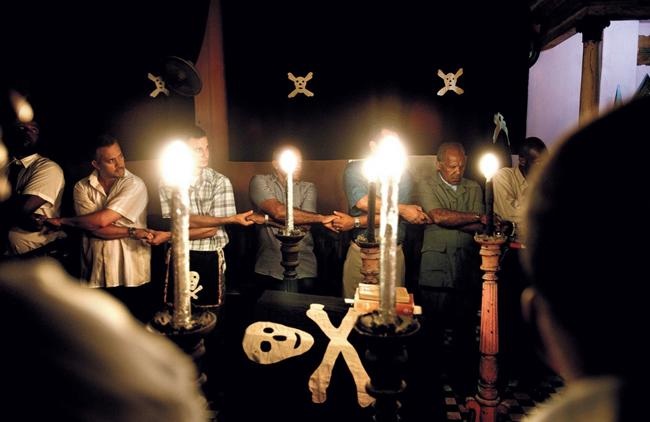
In a Masonic Lodge in Cuba, the rite of the chain of union or force, represented by the crossed hands and arms crossed of the brethren, is symbolic of the evident unity and power of Masonry. The Brotherhood is hoping to play an important role in the future of the country. 

Several unsupported stories, amounting to legends are common on the island, both in the media and in popular currency, even among some Masons, to explain this freedom. Some say that Fidel and Raul are Masons, more likely the latter. Others claim that it is the duty of gratitude and that during the Cuban revolution, Fidel Castro had taken refuge in a Masonic lodge, where he found shelter and protection. So he never closed even a single Masonic temple nor persecuted its members. Such stories cannot be corroborated and since similar stories exist relating to the relative tolerance shown to Afro-Cuban religion, we must remain skeptical until something more than simple assertion can be offered as evidence. The fact is that, today, the Grand Lodge of Cuba - the epicenter of the organization's activities in the country - is entirely regular and recognized by most major Masonic obediences around the world.
What is an indisputable fact, and which may have more to do with this tolerance, is that the very independence of Cuba was achieved with assistance from Cuban Freemasons. Freemasonry first emerged in Cuba in 1763, from English and Irish military lodges during the brief occupation of the island nation by Britain. When the British left, the French arrived by the thousands fleeing the revolution in Haiti in 1791. The first lodge was actually Cuban Theological Virtue Temple, founded in Havana in 1804 by the Grand Lodge of Louisiana and the famous French-Haitian Freemason Joseph Cerneau, honored throughout Hispanic, Franco-, and Luso-America by mainstream and cosmopolitan or liberal Freemasons alike.

What makes the presence of Freemasonry in Cuba uniquely respected is the role it played during the three decades of struggle for independence from Spanish rule between 1868 and 1895. The three great revolutionary leaders - José Martí, Antonio Maceo and the "father of the nation" Carlos Manuel de Céspedes were all Masons. Historians say today that it was the communist revolutionaries recognized and honored the Masonic affiliation of these three national heroes. But the truth is that little or no effort was made to repress Freemasonry. The vast majority of Cuban presidents, starting with Carlos Manuel de Céspedes, were Masons.

There are other curious features in the behavior of Freemasonry within Cuban society. Very little intervention or limitations  have been imposed on Freemasonry. This comfortable state of affairs may be due to the general support Cuban Masonic leaders have demonstrated for the government's policies. Yet, all Cubans are welcome regardless of their politics. A few lodges, outside the Grand Lodge, have begun admitting women to their ranks, which is welcomed generally in a society which formally eschews bias and discrimination.

After the breakup of the Soviet Union - which was the largest trading partner of Cuba - The Cuban government has further facilitated things for masonry, permitting it to participate in public ceremonies and open new lodges. However, the smooth functioning of all the Masonic lodges is still subject to permission from the authorities, and the publication of books and pamphlets is quite limited for Masonic groups due as much or more to financial limitation as government regulation.


The Grand Lodge of Cuba, popularly known as the Masonic Building, was built around 1955 for the functions of the temple and headquarters of the Masonic bodies of Cuba and came to the University Masonic lodge. It is an imposing building, included among the most significant architectural works in the city of Havana. It lies in the current Avenida Salvador Allende in central Havana. Without forgetting that the Chilean Salvador Allende, friend and ally of the Cuban Revolution, was a committed Mason.

A small lodge in the Sierra Maestras is credited as having hidden Fidel Castro in 1958 after his landing on Cuban shores in the ship named Granma.  A building in a remote village in the Sierra Maestra, the door Masonic symbols of the square and compass where it is said that in 1956 hid Fidel Castro who had just landed in the ship Granma. 

It was precisely within this old mountain lodge that future Maximum Leader has created the 26th of July Movement that in a few years would sweep away the dictatorship of Fulgencio Batista, inspired by the teachings of Jose Marti, the hero of the Cuban father independence movement on the island. 

Of course, many stories are told in Havana, including that the tolerance of Fidel toward Freemasonry is due to his affection for his teacher who was a Mason. That Father Angel, famous landowner, was affiliated with Freemsonry. It is a gesture of respect to his friend Salvador Allende, also a Mason. Even some right-wing theories, of which the Internet has unfortunately more than its share claim that Fidel or at least his brother Raul are initiates. This of course, is also said of them in relation to almost all of the Afro-Cuban religions as well as Haitian Vodú.

Today, on the island, there are officially 318 "regular" lodges frequented by over thirty thousand members. The number increased after the fall of the Berlin Wall.

Officially, the government praises Freemasonry for being associated with the noblest moments of Cuban history. Everyone hopes that in the future, Freemasonry will have an important role in the reconciliation process of the various factions of the country.

Not all lodges are in good condition. Many, especially those far from the capital, lie nearly in ruins. But all masons point to the Grand National Masonic Temple, the eleven storey building crowned by the Square and Compass, located at number 508 Avenida Salvador Allende in Havana as a source of pride. 

When it first opened in 1955, was one of the most modern buidings in Cuba. And it remains the best maintained, as witnessed today the small blue leather couches or columns topped by luminous globes. Here's where collective rites occur. It is here, within these walls, with its medals and swords, that the Grand Master and Grand Secretary retain their offices. There is also a museum, a library open to the public and an asylum that houses elderly Masons and administers donations - especially drugs - provided by American and European lodges.

Underground lies the dark "chamber of reflection" on it, along with skeletons and other symbols of vanitas (vanity) human, the aspirant begins to start their learning, "dies" and then is reborn to a new life within the community. A symbolic ritual that, in the country of African diasporic religious traditions, the syncretic traditions that unite African and Christian elements, was enriched with even more macabre passages.

But it may have been precisely this factor that prompted the mix, and subsequently, toleration. The Cuban government has always tolerated the symbols of Afro-Cuban tradition more than previous governments did. As happened in 1959 - a week after the flight of Batista - when during a rally, two white doves - symbols of Obatala, and Tiembla Tierra associated in Afro-Cuban traditions with Christ - land on Fidel's shoulders.

Afro-Cuban faith and Freemasonry, in short, both played a role in consensus building in Cuba after the Revolution. The first was useful to gain support from the largely Afro-cuban population  of the island who remain poorly represented in the government. The second ensured the sympathy of the Latin American left; the sickle and hammer on one side, and on the other the square and compass.

Thanks to Paulo Antonio de F. Lobo and João Carlos del Bianco, brethren from Brazil.

Thursday, March 7, 2013

Rough Ashlar No. 5


I opened the first of the Rough Ashlar posts by noting that doubtlessly those of our brethren resistant to the idea that working on the rough ashlar means changing that with which one is comfortable, will accuse me of being unjustly critical of the status quo. I thank them for the complement. I am simply noting the truth. If someone doesn't find the truth comfortable, change it.

My topic today is on grumpy old men. I am looking in the mirror as I write this hoping that I will not, as Jackson Browne wryly noted in one of his songs, hear my own words offered back to me.

I am well aware that it is a common if not inevitable human response to resist change. We become comfortable and perhaps, at a certain point in our lives, simply do not wish to deal with further change, especially when we have lapsed into romantic nostalgia concerning our own fictive past. However, there is I believe, a special sort of grumpy old man endemic in mainstream masonry today. I know a few of them. Apart from their extreme orneriness when it comes to facing uncomfortable realities, they are mostly decent folk.

They are none the less, impediments to the survival of Freemasonry, and their behaviors are decidedly un-masonic. Perhaps, they may be forgiven. I have been reminded from time to time by my loved ones that I can be a pain in the ass. Guilty as charged.

Maybe they are right and there is no such thing as masonic education, and that each individual has to do that themselves. I was laboring under the delusion that I was given one. Indeed, part of my masonic education included the idea that one needed to apply critical thinking to all subjects, even when it leads us to unpleasant realizations.

Freemasonry is in need of change. If it is to survive as a significant institution, it must embrace the 21st century in ways that mainstream masonry at least, has been loath to do thus far. Grumpy old men who call anyone who upsets them, un-masonic, are part of the problem, not the solution.

The focus of this Rough Ashlar isn't really grumpy old men. They are only the delivery system of the message that sometimes human institutions get so stuck in the past that they are willing, like the proverbial lemmings, to run en masse over the cliff into oblivion rather than accept that change is not only inevitable, but necessary.  Calling the messengers of this truth "un-masonic" is itself un-masonic. It denies the good intentions of the messenger, it casts them in the role of the bad guy, and it denies reality.

I may be a grumpy old man myself. At least though, I am one who is open to change and cares more about seeing an institution which he values survive than seeing it become no more than a fond memory of the past.