Showing posts with label Philadelphia. Show all posts

Friday, July 4, 2014

Space is the Place: Sun-Ra: Philadelphia & Freemasonry

Once upon a time, back in the 1920s, there was a boy in Birmingham, Alabama who was an honor student at the local high school. He was an avid reader,  and something of a loner. He was possessed of a vivd imagination and he fed that by learning all he could. It is said that he reading everything in the library at the local Prince Hall Lodge, including their collection of books on esoteric concepts and Freemasonry. 

That boy was named Herman Poole Blount. He would eventually change his name to Sony'r Ra, and a variant of that name, Ra Le Sony'r appears on the city records as the owner of his home of many decades at 5626 Morton Street, in Philadelphia's historic Germantown neighborhood. That neighborhood was famous as the home of an early pietist sect of Germans, led by Johannes Kelpius, whom AMORC tries to claim were Rosicrucians. Kelpius suffered, perhaps more after his death than during his life, from being misunderstood and underestimated. Perhaps it is a neighborhood curse, because that can certainly be said of Herman Poole Blount, as well.  Although he became famous world-wide under the name of Sun-Ra, while leading his jazz group The Arkestra, he remains today, 21 years after his departure from this plane of existence, far too underappreciated, whether for his remarkable contribution to avant-guarde Jazz, or to 20th Century Esoteric thought. 
The Encyclopedia of Jazz Musicians has this to say of Sun-Ra:
"The greatest of all jazz eccentrics, Sun Ra inspires both fascination and controversy. The bandleader's singular, cosmic vision led him to transcend hardship, derision, and obscurity. An unparalleled performer, he led an expansive yet coherent band of as many as thirty players over four decades, and his vast recorded legacy refutes those who deny his talent. Primarily known as the creator of the "Arkestra," his polymorphic big band, Ra could also be comfortably described as a composer, performer, poet, philosopher, and visionary.

Born Herman Poole Blount in Birmingham, Alabama on May 22, 1914, he legally changed his name to Sony'r Ra in October of 1952. After this date, when questioned about his early life, he insisted he was a visitor from the planet Saturn, and only gave vague indications of his past experiences.

Little Herman began playing piano early in life, and could sight-read and compose by age 11. Birmingham hosted many of the era's most famous performers, and the boy experienced the live sounds of, among others, the bands of Fletcher Henderson, Duke Ellington, and Fats Waller. The young prodigy was said to be able to produce full transcriptions, from memory, of big band performances he had witnessed and was working as a semi-professional pianist by his mid-teens.(web http://www.jazz.com/encyclopedia/ra-sun-herman. 7/4/2014)

Thom Holms notes in his book, American Popular Music: JAZZ, that  "Sun Ra was a great bandleader, able to manage a wide range of sounds and players into an absorbing and unique jazz experience. He should be discussed in the same light as equally provocative and accomplished avant-garde jazz legends John Coltrane, Cecil Taylor, and Ornette Coleman, but he is more often neglected than taken seriously. There are more than 100 recordings of Sun Ra’s music…most produced on his tiny Saturn label, and most not available on compact disc." (2006: 190)

Sun Ra leaned to read music without any training. He did however, acquire more formal music training. In high school, he was a member of several bands and also led his own bands. Some of these bands went on tours, and performed in areas such as Chicago, the East Coast, and the South. He attended Alabama A & M, a black college, where he majored in music education and teacher's training. In the late 1930s he spent time in Indiana and Washington D. C. At the end of the 1930s, he moved to Chicago, where he began his professional career and which was his base of operations for a long period of time. While his music was phenomenal, and he attracted some excellent musicians who were also fascinating individuals and excellent conversationalists, it is his perhaps eccentric esoteric thought that interests us today. 


In The Cosmic-myth Equations of Sun Ra: An Examination of the Unity of Music and Philosophy of an American Creative Improvising Musician (UCLA 1991), David A. Martinelli states that Sun Ra has his own term for what could be called his ethos, world-view, ideology, or philosophy. This term is "equations". Sun Ra has made it clear that he is not dealing with philosophy. He has said "People ask me about my philosophy all the time, but it's not a philosophy, it's an equation". When asked "Has this sort of philosophy been with you ever since the beginning, ever since the (Fletcher) Henderson band?", Sun Ra responded "Philosophy is conjecture. I'm dealing with equations. That's different from philosophy. Philosophy is something like religion, it's a theory. It could be true or not true. But I'm not dealing with theories, I'm dealing with equations". 

Martinelli also indicates that further sources that shed light on Sun Ra's beliefs include Christianity, and Freemasonry and Freemasonry, Ancient Egypt, and Carl Jung's "Flying Saucers: A Modern Myth of Things Seen in the Sky." 

Sun-Ra's " idea of equations is perhaps best described in his poem "A Blueprint/Declaration":

One part of an equation

Is a blueprint/declaration of the other part

Similar

Yet differentially not. . .

It is nothing

If it is all

Still there are different alls

The end is all

But all is everything

Yet if everything is all/the end

It denies the other side of the end

For some ends

Have many points leading to their respective selves

And there are/is each/their many points

Leading out from their

Respective selves

(Sun Ra 1985).

Sun Ra viewed himself as existing apart from humanity. Sun Ra felt that he was limited byhumanity Earth, that he was not free. He said, "I see myself as P-H-R-E but not F-R-E-E. That's the name of the sun in ancient Egypt. I'm not really a person at all" and "Some people are controlled by forces on other planets. I am, so I'm not really free" 

Sun Ra's philosophical ideas or equations are difficult for some to take seriously. Those who separate the equations from the music are missing a great deal. Sun Ra's ideas on duality, the pyramids, the Sphinx, the sun, Ufos, the planet Saturn, and the number nine, symbolize the potential unity of humanity, mentally, physically, and spiritually.

While some may not wish to see a connection between Sun-Ra and Freemasonry, however tenuously you may view it, much of his initial inspirations he owed to that Prince Hall Lodge library back in Birmingham. Whatever you may think of his philosophy, and his music, he had a powerful message, and one which is some fundamental ways, reflects some of the more profound messages found in Freemasonry. If this has sparked your curiosity about the man, his philosophy, or his music, watch the video below. You will at least find it interesting.


http://www.sunraarkestra.com/

Tuesday, June 10, 2014

The Scottish Rite Town Hall in Philadelphia

Out of a number of Philadelphia's architectural treasures were lost to the parking craze of the 1980's, the Scottish Rite Temple, which was also known as Town Hall was located at 150 North Broad Street (Broad and Race Streets). The Temple was built in 1926 and designed by Horace W. Castor (1870-. It is one of those lost treasures of which I hold fond personal memories. The soaring, stone walls of the Scottish Rite Temple fell to the wrecking ball in 1983 to make way for Parkway Corporation's poorly designed garage and headquarters. The latter unlike the beautiful Scottish Rite Temple, is unfortunately still with us.

The Scottish Rite Temple was most often called Town Hall when it was an active venue for entertainment from at least the 1950's until shortly before its demolution in 1983.

I never attended any events directly related to the Scottish Rite there, but I did attend a number of concerts there, especially in the 1960's.

The Architectural style of the Scottish Rite Temple was called variously Classical Revival, Beaux Arts, or Art Deco. It should be noted that at the time that an agency of the City of Philadelphia demolished it, it had an eligible status for placement on the National Register of Historic Buildings. It was constructed of Limestone with Steel Reinforcement, and Terra Cotta.

During the time when the  Philadelphia Orchestra was under the batons of both Leopold Stokowski and Eugene Ormandy, they recorded at  the Scottish Rite Cathedral which had a 1,692 seat auditorium with bright resonant acoustics that made for "high fidelity" recordings.

In the late 1950's after especially during the 1960's, big name acts often performed there. In 1957, Tom Lehrer and Josh White performed there. On November 17th, 1955, and March 1, 1959, Ray Charles performed concerts there. Bob Dylan performed there no less than three times in the fall of 1964. The Doors and Nazz performed there in June, of 1967.

I went to one of the Dylan concerts in 1964, and while I cannot recall the full set list of that concert, I do recall hearing him sing "Mr. Tamborurine Man", "It Ain't Me, Babe", and "Don't Think Twice, It's Alright." However, the Live Show Archive lists the set he played at The Scottish Rite Temple on October 25, the year before, as including the following:

1. The Times They Are A-Changin'
2. Girl from the North Country
3. Who Killed Davey Moore?
4. Talkin' John Birch Society Paranoid Blues
5. To Ramona
6. Ballad of Hollis Brown

7. Chimes of Freedom
8. I Don't Believe You
9. It's Alright Ma (I'm Only Bleeding)
10. Mr. Tambourine Man
11. Talkin' World War III Blues
12. A Hard Rain's A-Gonna Fall
13. Don't Think Twice, It's All Right
14. Only a Pawn in Their Game
15. With God on Our Side
16. It Ain't Me, Babe
17. The Lonesome Death of Hattie Carroll
18. All I Really Want to Do

I remember the Doors concert as being even more impressive than Dylan.

Among others who performed there were Todd Rundgren, Keith Jarrett, Charles Lloyd, Ron McClure, and Jack DeJohnette.

Ironically, one of the things I remember most clearly was that my brother and I sat so far up in the nosebleed section that I felt actually scared for the first few minutes.

My last recollection of the old Scottish Rite Temple was not as fond. I walked past it while it was being demolished, and had a flood of recollections, and felt profound sadness at seeing such a beautiful building being torn down. Not even world class architecture is a match for the lack of vision that most government bureaucrats possess.

Sunday, September 22, 2013

Octavius V. Catto African-American Elks Lodge

Octavius V. Catto African-American Elks Lodge banner, 1903. Maker unknown; velvet, gold embroidery, fringe and wood. Philadelphia History Museum at the Atwater Kent

The banner commemorates the 1903 opening of the Octavius V. Catto Lodge, the Philadelphia home of the Improved Benevolent and Protective Order of the Elks of the World (IBPOEW), also known as the Black Elks. Fraternal organizations such as the Elks were increasingly common in the late nineteenth century, though such groups often established distinct chapters segregated by race.

The Black Elks, formed in Cincinnati in 1898 by Arthur Riggs and B.F. Howard, were a controversial offshoot of the exclusively white Benevolent Protective Order of the Elks (BPOE). After failing to gain acceptance into the BPOE, Arthur Riggs sought legal counsel and filed for copyright of the still unpatented BPOE meeting ritual. Although violent threats forced Riggs to relocate to Springfield, Ohio under an assumed name, the Black Elks endured under Howard and local chapters throughout the United States began to emerge.

Philadelphia's chapter of the Black Elks is one such example, and Octavius Catto (1839-1871) proved a fitting namesake for the lodge. A prominent educator and activist during and after the Civil War, Catto is reflective of nineteenth century Philadelphia's dynamic and vibrant black middle class. Born in South Carolina in 1839, Catto and his family settled in Philadelphia around 1850. He studied at the highly-regarded Institute for Colored Youth and eventually served as educator and assistant to the principal upon graduating in 1858.

A staunch advocate of equal rights among men, Catto became increasingly involved in political action, both formal and informal. During the Civil War, he and Frederick Douglass were instrumental in recruiting black volunteer regiments in and around Philadelphia, many of whom served in battle. In 1865 he staged a demonstration of civil disobedience against Philadelphia streetcar companies, which did not board black men and women. Having entered a streetcar, Catto quietly refused to get off when urged to by the conductor.

When the conductor eventually chose to derail the car, Catto remained seated in silence well after the car had emptied. The event received national attention. Threats of legal action were made against Catto, but he ultimately escaped reprimand. In 1866, with his friend Jacob C. White, Catto formed the Pythians baseball club. The Pythians club served three functions: first, it provided a social recreational network for members of the black community, many of whom knew each other from their days at the Institute for Colored Youth; second, it served as a political stage to demonstrate African Americans' love and mastery of an increasingly popular and distinctly American game; and third, it provided a means to negotiate acceptance into white administrative organizations such as the Pennsylvania Association of Amateur Base Ball Players (the Pythians were ultimately denied acceptance). As player-manger and skilled shortstop, Catto was well recognized on and off the field. Catto further lobbied for black citizenship as a supporter of the Republican Party. He served as secretary in the Republican-organized Pennsylvania Equal Rights League.

His political involvement brought his young and accomplished life to a sad, untimely end. In 1871, a year removed from Pennsylvania's adoption of the 15th Amendment, which granted voting rights to black males, racial tensions ran high in the city of Philadelphia. Newly enfranchised black citizens, who almost exclusively supported Republican candidates, posed a significant threat to Democratic leaders, who relied heavily on white support. On Election Day, October 10, 1871, rioters sought to suppress the black vote, largely by violent means. Catto himself was confronted on the street and shot to death by Frank Kelly, likely an act of political murder motivated by Catto's civil rights activism. Kelly stood trial in 1877 but escaped conviction. Catto's death was mourned by the city, by white and black alike. His legacy lived on in the benevolent work of the Elks and black fraternal organizations throughout the region.


Based upon original page on http://www.philadelphiahistory.org/

Sunday, December 9, 2012

Johannes Kelpius - Not America's First Rosicrucian


A significant portion of my youth was spent in Philadelphia and I was immersed in the stories and legends of the area, even though many of my contemporaries paid little attention to them. The most fascinating of these were doubtlessly the stories I heard about the mad visionary monk or magician who lived alongside the Wissahickon Creek. The legends were fantastic, and the fact that they seemed to contradict themselves and left room for the suspicion that the truth was something other, did nothing to dampen my enthusiasm for the most outrageous of them.

In graduate school I did a little more digging and found many fascinating facts about the magician of the legends I heard as a child. Unfortunately, I have found that most adults are not as interested in finding the truth as I was. So, a recent visit by a friend which led me to take him to see the sites associated with the legends if not the facts, has led me to publicly right a few of the most commonly circulated errors.

Johannes Kelpius
The man I am referring to was a well educated German Pietist from what is now Switzerland. Actually, this man, most commonly known today as Johannes Kelpius, was born in Transylvania. He was a radical pietist. For those who wish to make the claim that he was America's first Rosicrucian, including AMORC, I am sorry to burst your bubble. Radical Pietists were not Rosicrucians. They certainly influenced what came to be known as Rosicrucianism, but they were no more Rosicrucians than ancient Jews were Christians because the Christian faith grew out of Judaism.

The small band of German pietists who settled in the Wissahickon Valley in 1694 were initially recruited by Johann Jacob Zimmerman, a former Lutheran minister and professor at Heidelberg University, disenfranchised by the church and dismissed from his academic post for his Pietist and millennialist beliefs. Religious wars devastated much of Europe throughout the seventeenth century, particularly Germany, then the Holy Roman Empire, during the Thirty Years War from 1618-1648.

Root Cellar not really associated with Kelpius
Johannes Kelpius, the man who lead this group, was born in Transylvania around 1667. Born to a Lutheran pastor, he developed an interest in theology at a young age. Kelpius excelled as a scholar and received a doctorate of philosophy and the liberal arts in Nuremburg in 1689, where he received a "thorough scientific and religious education." He became fluent in German, English, Latin, Hebrew, and Greek and used his knowledge for religious study and philosophy. The young man continued his studies and attended the University of Altdorf, where Dr. Johannes Fabricus closely nurtured his academic ambitions. Kelpius's prowess was such that, during his first year at Altdorf, he collaborated with his mentor to publish two books in 1690.

During his life, Kelpius witnessed the growth of the religious and mystical movement called Pietism. It originally began as a faction of Lutheranism in Rome, but spread across Europe and grew particularly in Germany. Pietism rejected reliance on institutionalized religion and instead advocated deeper personal relationships with the spiritual world. Mystics especially found Pietism attractive because of its similarities to their own beliefs. Pietism's popularity spread quickly in Germany's intellectual community and shaped the academic environment that Kelpius studied in.

Although Kelpius guided the Pietists to America, he was not the group's original leader. Johannes Zimmermann, a noted mathematician and astronomer, took to mysticism and became convinced that Jesus Christ would descend from the heavens to begin the millennium in March of 1694. To prepare for the Second Coming, Zimmermann organized a group of forty devotees (including himself) to await the return of Christ in the New World. The work that Fabricus and Kelpius published impressed Zimmermann, and he sought out and recruited Kelpius as his Deputy Magister.

Wissahickon Monastery
Under Zimmermann's direction, the group planned to settle in the woods surrounding the scarcely-settled Philadelphia. Pennsylvania proved an obvious choice with its reputation for religious tolerance and secluded environment where the Pietists could devote themselves to perfecting their souls uninterrupted. The wilderness, they concluded, provided them with the best environment to receive divine revelation in the manner that Moses and Elijah had. Furthermore, the port at Philadelphia was near the fortieth parallel. Mystics considered forty to be the perfect number, as Moses spent forty days on Mt. Sinai, and Christ wandered in the desert for 40 days, among other things.

Ephrata Cloister
In the summer of 1693, Zimmermann's group of forty Pietists rallied in Rotterdam, Holland, where they prepared for their journey. A Dutch Quaker, believed to be William Penn's Rotterdam agent, Benjamin Furley, took an interest in the group and their beliefs and provided them with 2,400 acres of land in the new world and £130 for their passage. Zimmermann's unexpected death later that year delayed the group's journey. Kelpius took Zimmermann's place as leader, and after restoring the group's membership to forty, Kelpius, "convinced by God, resolved upon going to America." On February 13, 1694, Kelpius boarded the English Sarah Maria and set sail. After many adventures, documented in Kelpius' Diary, which survives, the band arrived in Philadelphia.

According to Philadelphia legend, they marched to Fairmount. For those of you unfamiliar with the historic names of Philadelphia geography, that is the location where several centuries later Rocky Balboa ran up the museum steps in the movie. where they lit fires and celebrated St. John's day.

Ephrata Song Book
Legend also neglects to note that Kelpius and his group lived a life that was anything but removed from the German speaking community which occupied what is still called Germantown today. They taught children, grew a large botanical garden to help heal illnesses on the site where the Philadelphia Cricket Club Golf Course now exists. Legend also makes no mention of the fact that the monks, including Kelpius made a killing in local real estate, and that Kelpius went on to win a legal suit against him for real estate fraud. Kelpius and his followers performed what may have been the first chamber music concert in North America in Old Swede's Church, and the portrait of Kelpius by Christopher Witt, who founded Pennsylvania Hospital, is the oldest portrait in the United States.

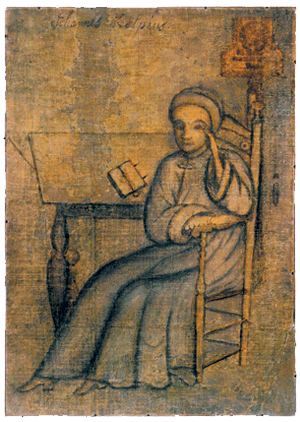
"Lady in the Wilderness" from Ephrata
The Pietists, who believed literally that the return of Christ was imminent, were disappointed when the appointed date came and went, and many ended up leaving to live in Germantown. Kelpius stayed on with Conrad Mathai. When Kelpius died in 1708, having had to be removed to Germantown to convalesce, this left Mathai and six of the original 40 still living at the monastery. This was the group which met Conrad Beissel who arrived in 1720 to join the group which locals had nicknamed "The Woman in the Wilderness," after the imagery of the New Testament Book of Revelations.

Beissel, went on to lead a group to found a similar Pietist community in Effrata, Pennsylvania in 1730. The community prospered while Beissel lived, but began to decline after his death. In 1814, the scant few remaining dwellers of Ephrata Cloister incorporated themselves as the Seventh Day German Baptist Church, a title which survived until 1934. With its future in limbo during the late 1920's, these few members recognized the end of their communal experiment but strongly disagreed on how to best dispose of the grounds, buildings, and artifacts which held considerable monetary and historical value. The arguments escalated into legal action against each other to such a degree that the courts revoked the incorporation of their charter and placed the property under receivership. The Pennsylvania Historical and Museum Commission assumed ownership of the grounds and buildings in 1941, with a program of research, interpretation, and careful restoration.

Nothing remains of the original Temple built by Kelpius and his followers, and while we know the general area where it was located, we do not know the exact location. The Monastery House most likely was built after Kelpius' death and is understood to have belonged to the group under Beissel's leadership which subsequently moved to the Cloisters in Ephrata, Pa. Of course, it might also have been used by the Dunkers, another Pennsylvania religious community which coexisted in the Wissahickon.

Böhmeian Philosophical Illustration
What exactly did they believe and teach? They were first and foremost Lutherans. They rebelled against the rigidity of the Lutheranism of their day, but they were essentially Lutherans with a mystical worldview. This was the same forge out of which what we today call Rosicrucianism was born. There were certain minor similarities and parallels, but there were also significant differences between the two philosophies. Sorry AMORC, your impressive plaque at the site of the root cellar both you and local folklore incorrectly identify as The Hermit's Cave is incorrect on two points. The first is that this location was not used by Kelpius, although he may have walked close by where it today stands. The second is that Kelpius was not a Rosicrucian, nor would he have self-identified as one. It is even quite possible that he was not familiar with the term. It certainly is not mentioned in any of the brief works we have which can be identified as his work. So, while it pleases me to see that you have honored Philadelphia's favorite esoteric son, for some of us at least, accuracy matters. Had your memorial sign read "Kelpius was a Radical Pietist whose faith in many ways anticipated modern Rosicrucianism" it would not have as much dramatic impact in your favor, but it would have been a lot more historically accurate, and that would be welcome. Instead, setting themselves up as an authority, they have perpetrated the spread of misinformation. That is unfortunate.

Kelpius was a follower of Böhmeianism  We might today call him a Bohemian, as the modern term it is claimed has been influenced both by the term Böhmeianism and the region known as Bohemia. One of Boehme's most influential works was named Aurora. In that book, he defined seven major qualities, planets and humoral-elemental associations:

1. Dry - Saturn - melancholy, power of death;
2. Sweet - Jupiter - sanguine, gentle source of life;
3. Bitter - Mars - choleric, destructive source of life;
4. Fire - Sun/Moon - night/day; evil/good; sin/virtue; Moon, later = phlegmatic, watery;
5. Love - Venus - love of life, spiritual rebirth;
6. Sound - Mercury - keen spirit, illumination, expression;
7. Corpus - Earth - totality of forces awaiting rebirth.
In "De Tribus Principiis" or "On the Three Principles of Divine Being" Böhme subsumed the seven principles into the Trinity:
1. The "dark world" of the Father (Qualities 1-2-3);
2. The "light world" of the Holy Spirit (Qualities 5-6-7);
3. "This world" of Satan and Christ (Quality 4).  

Grave of Conrad Beissel
Böhmeianism does not describe the beliefs of any single religious group, rather, it is a more general description of Böhme's interpretation of Christianity. Böhme influenced many anti-authoritarian and Christian mystical movements, such as the Religious Society of Friends (Quakers), the Philadelphians,  the Gichtelians, the Society of the Woman in the Wilderness (Kelpius' group), the Ephrata Cloister, the Harmony Society, Martinism, and Christian theosophy. Böhme was also an important source of German Romantic philosophy, influencing Schelling. Richard Bucke, in his 1901 treatise Cosmic Consciousness, gave special attention to Böhme's spiritual enlightenment. Böhme is also an important influence on the ideas of the English Romantic poet, artist and mystic William Blake.

Wednesday, August 15, 2012

The traditional Modern Rite in North America and the Caribbean


The Modern Rite has issued Patents for North America and the Caribbean

The structure of the Universal Masonic Union of the Modern Rite (UMURM), walks slowly, at its own pace and attempts to remain aloof to controversy.

It has been suggested by some that the renewal of the Traditional Modern Rite will not come from Europe,but rather would take place on another continent such as in the Americas. The Rite will continue walking until there comes a day when rejuvenated and modernized it will be well adapted to new forms and visions. What all masonry needs now are new forms and visions, as the old does not seem able to reverse the (sometimes not so slow) decline.

It should be the desire of all masons to embrace a plural and critical view, knowing that all that information is a tool for the rest, so that everyone understands and handle it properly.

THis is why the UMURM, and the Academy, and specific individuals within these structures, working with brethren in the US and the Caribbean, developing through knowledge and relationships they have done with some brothers from the USA, have been able to raise the Modern Rite in the USA.

The Modern Rite in North America and the Caribbean support the Barcelona Charter drafted in June 2011 and are part of the Union Masonic Rite of Modern World (UMURM).

The Western Hemisphere is now organized for practicing Modern Rite according to the great traditions and heritage as preserved by the Masonic Supreme Council of the Modern Rite of Brazil, whose work takes place in an unbroken chain from 1842 to today , and whose rich heritage was rooted, long before that date, in the soil of the Modern Rite. (...)

The priority is now to work at making available a body of literature concerning the Modern Rite, which in all respects, is simply nonexistent in English. Our brothers in Cuba have an embarrassment of riches, thanks to the efforts of the Spanish in recent years. We plan to produce educational materials on historical topics, as well, and this is of immediate importance, literature appropriate to the needs of researchers and related rituals, ethics and traditions of the Modern Rite. Our commitment to research, education, and courteous debate, whether in or outside the box, and our need to translate the ritual, make a goal like this one an essential objective. We will make sure to share intellectual and moral values  and perspectives of the Modern Rite, rituals and ethics. (...)


This open letter announces that on July 27, 2012 the Supreme Conselho do Modern Rite based in Brazil, under the distinguished leadership of M. '. I. '. H. '. José María Bonachi Batalla, Sovereign Grand Inspector General, working in the Valley of Rio de Janeiro, granted the Letter Patent for the Orders of Wisdom I ∞, II ∞, III ∞ and IV ∞ Order of Modern Rite to the Grand Chapter General of the Modern Rite of North America and the Caribbean.

The General Grand Chapter of the Modern Rite of North America and the Caribbean will be working with the Orders of Wisdom, Brazilian rituals, to be translated from Portuguese.

In addition, the first Grand Master of the Grand Lodge of the Mixed Modern Rite of North America and the Caribbean, working in the Orient of Philadelphia, it is a great honor to announce on behalf of their brothers and sisters, in the United States and Cuba (where several lodges under the lead of Logia Anáhuac are already working with more to come), this Symbolic Power has received its charter from the Grand Mixed Lodge of the Equatorial Andes,  from the hands of M. '. I. '. Hna. '. Olga Vallejo Rueda, S. '. C. '. Sublime Council of Modern Rite for Ecuador. The patent was received on July 12, 2012.

To see the full open letter follow the link below, or click on the bold text at the top of this window.:


http://unionmasonicauniversalritomoderno.blogspot.com/2012/08/lettre-ouverte-des-francs-macons.html


Gracias a Joaquim, Olga, VIctor y el muy venerable JosÈ Maria por todo sus apoyos.

Thursday, May 31, 2012

Odunde 2012

What is the ODUNDE festival?

 ODUNDE attracts UP TO 500,000 people annually and is one of the largest community- based street  festivals held in the United States. The festival, whose concept originates from the Yoruba people of Nigeria, West Africa, celebrates the coming of another year for African Americans and Africanized people around the world.  It is an occasion highlighted by a colorful procession from  23rd and South Streets to the Schuylkill River where an offering of  fruit and flowers is made to Oshun, the Yoruba goddess of the river.  ODUNDE is also known for its authentic African  marketplace featuring vendors from around the  world selling merchandise  from many African nations, the Caribbean and Brazil.
       
Each year, the second Sunday in June, ODUNDE, one of the nations oldest African American street festivals takes place.  ODUNDE will be celebrating its 37TH year in its traditional south Philadelphia location near 23rd and South streets. The festival started in 1975 with a $100.00 grant and neighbors from Fernandez's South Philadelphia community.  In two years the ODUNDE Festival exploded.  The eclectic mix of vendors, entertainment and music started to draw people from around and beyond the region and each year continues to be no different.  


ODUNDE is not only one of the nation's oldest African American street festivals, it is one of the nation's largest street festivals of any kind.  The area of the festival, including the hundreds of vendors covers over 12 city blocks. The attendees come not only from Philadelphia and the tri-state area of Pennsylvania, Delaware, and New Jersey, but fully a third of the attendees come from further away. It is phenomenal. This year there will be a special emphasis on events and entertainment connected with Bahia, Brazil. 

Special Events include: Coffee Tasting next week at Reading Terminal Market...Coffee from Bahia, and AMMA choclate...organic choclate from Bahia... In honor of 100 years of Jorge Amado who wrote about coffee, "numa xicara de cafe, pode-se colocar a beleza do mundo. Numa xicara de cafe, pode -se sentir o sabor amargo e doce da vida ... in a cup of coffee, one can put all the beauty in the world...in a cup of coffee, one can feel the bitter and sweet taste of life. " Salve Jorge....June 7th..come have coffee.


Special Thanks to Dr. Ken Dossar, Suzana Silva, and Julio Casoy whose hard work helped to bring many Brazilian dignitaries and FIFA World Cup officials to the City of Philadelphia this year!!!!

Wednesday, February 8, 2012

We See Dead People

This was just too juicy to pass up. If you will forgive the bad pun, I have always loved haunting the University of Pennsylvania Museum of Archaeology and Anthropology. I first became aware of this museum when I was in grade school. Back in the 1950s, the museum produced a television series which aired on Philadelphia's WCAU TV called What in the World.Produced by the Penn Museum, and created by its then director Froelich Rainey, What in the World was a pioneering museum education project during the dawn of the telecommunications age. Penn Museum's Peabody Award-winning popular weekly half-hour television program was first seen in 1951 and which ran for 14 years. By the early 1960s it was one of the oldest programs on television.

Seeing this program every week on television and discovering that I lived only a mile from the place where it was recorded was too much to resist. I begged my older brother to take me there whenever I could get the chance. Fortunately, he often obliged. Later, my first grade school girlfriend's mother worked in the museum gift shop and that was an even better excuse to visit.

When I entered graduate school at the University of Pennsylvania, I made weekly visits to the museum and the University's library dedicated to Anthropology which is housed within the museum, as well as taking classes under the auspices of the Dept of Anthropology which occupies an upper floor.

So, when I saw this video "teaser" this morning, I simply could not resist sharing it here. Check it out. And if you are curious, check out the old footage of What in the World, there are a few examples on Youtube and although very dated, they are still worth watching. By the way, the University of Pennsylvania Musuem has an amazing Egyptian collection, including many mummies, and the reconstruction of the throne room of the Merenptah Palace from Memphis, which was sacred to the god Ptah, his consort Sekhmet and the third member of the Memphite Triad, Nefertem.

See the ghostly denizens of the University of Pennsylvania Museum of Archaeology and Anthropology. Just perhaps I was a student of one of them. Alas, you will have to travel back in time a few months if you wish to attend the event, which was part of their program for school children, but it is none the less a fun way to introduce people to this wonderful resource. Check out their extensive website, the gift shop, and if you find yourself in Philadelphia, you really must include a visit to this amazing location. The extensive Egyptian collection should fascinate any Freemason, and the mummies will delight the kids if you have them with you.