Given the almost constant string of scandals issuing from (primarily southern) jurisdictions one could be forgiven for concluding that Freemasonry is synonymous with immorality and a lack of ethics. Now, I have heard and from sources that usually are credible, that such is not the case. I'm beginning to question the traditional characterization, however.
It also seems increasingly clear that the only place where morality and ethics has any expression within mainstream Freemasonry in the US is through the blogosphere. It appears to be totally absent on the Grand Lodge level, and those who are committed to the current establishment too easily forget their vows. It also appears that the average mainstream mason has interpreted, wrongly I might add, that loyalty to the fraternity is measured by loyalty to the dictates of a corrupt establishment managed by leaders devoid of any ethical compass.
The fact that the rest of the Grand Lodges largely avoid the unpleasantness of commenting on the sins of their sister lodges rather than allowing them to avoid "contagion" results in their mutual moral culpability. At a certain point, one can no longer remain moral if you remain silent. Delay only makes matters worse.
Fortunately, a few Masonic bloggers have spoken out on this sad series of affairs. Brothers Mark Koltko-Rivera and Frederic L. Milliken have taken the brave and moral decision to speak out in active ways to correct these most recent injustices. Brother Koltko-Rivera has begun a petition to void the Grandmaster's ruling in Florida to ban masons who are pagans as a violation of masonic rules, and Brother Milliken has called on other jurisdictions to pull recognition from the Grand Lodge of Arkansas for their most recent mishandling of the Shriner situation, but also in light of all the other banishings they have engaged in in recent times.
Visit their links and read them for yourself:
http://themasonicblog.blogspot.com/2012/12/resolution-to-revoke-floridas-ruling.html
http://www.freemasoninformation.com/category/bee_hive/
More importantly, support and join their efforts.
Doubtlessly, both these good brethren will be challenged and insulted by the mindless followers of mainstream Grand Lodges and I will, yet again, be told, as a "bogus mason" to piss off. It's a small price to pay for occupying the only moral position in this debate. Well done Mark and Fred! I am proud to count you as brothers and friends whether you are allowed to share in masonic discourse with me or not.
Saturday, December 22, 2012
Thursday, December 20, 2012
Lisbon & Barcelona — The Modern Rite
Lisbon-Barcelona (Modern French Rite) ADDENDUM
Revista. Riot Francés
When the French Rite magazine was first visualized a year ago, and eventually offered for download, there was a major issue that Victor Guerra spoke of in his announcement post that accompanied the magazine, but it was not referenced in the magazine. The subject in question concerns the two announcements that were issued with respect to the Modern French Rite by Lisbon and Barcelona.
Click on link below each journal to download them in PDF
The first, published in Lisbon is linked to the General Grand Chapter of GODF French Rite, and the other was born as an answer to that effort and led to the Unión Masónico Universal Rito Moderno (UMURM) and relates to the Modern Rite in Barcelona.
Arguably the first intended to be "Union Center", and the second is intended to be "Unity Center", which may appear synonymous, but isn't because the first part reflects an Andolusian heritage which is tied to the hegemony of GODF Freemasonry, and the other is the daughter of the projected balance "Régulateur du Maçon."
These two famous Charters: Lisbon and Barcelona marked two milestones, and two ways of equidistance, and which were the reason why for the No. 1 magazine French Ritewas led off by Brother William Fuchslocher, one of the first to have studied and worked on the French Rite in Spanish.
From this distant perspective I ordered analytical work on these letters and full freedom once I had published several articles published low these titles: Live the Caenas and also: Analysis of the Charter of the French Rite, signed in Lisbon.
The analysis of these two works is delivered today as an addendum, after almost one year in the making.
These articles can be reached by the links below:
Unión Masónica Universal Rito Moderno
Academia Internacional del V° Orden del Rito Moderno
Gracias a Victor Guerra
Sunday, December 16, 2012
Dreams that Matter; Books that Reveal
Dreams That Matter:
Egyptian Landscapes of the Imagination
Amira Mittermaier
University of Califormia Press
Berkeley Los Angeles London
2011
There are some books which deal directly with Freemasonry and yet are peripheral to Freemasonry's essence, and there are some which do not touch on the subject of Freemasonry directly, but could not be more central to them. Dreams That Matter Egyptian Landscapes of the Imagination by Amira Mittermaier
The official description that the publishers offer states that
"Dreams that Matter explores the social and material life of dreams in contemporary Cairo. Amira Mittermaier guides the reader through landscapes of the imagination that feature Muslim dream interpreters who draw on Freud, reformists who dismiss all forms of divination as superstition, a Sufi devotional group that keeps a diary of dreams related to its shaykh, and ordinary believers who speak of moving encounters with the Prophet Muhammad. In close dialogue with her Egyptian interlocutors, Islamic textual traditions, and Western theorists, Mittermaier teases out the dream's ethical, political, and religious implications. Her book is a provocative examination of how present-day Muslims encounter and engage the Divine that offers a different perspective on the Islamic Revival. Dreams That Matter opens up new spaces for an anthropology of the imagination, inviting us to rethink both the imagined and the real. "
Mittermaier writes an interesting and connected account of her research on contemporary oneriology* and anthropology in Cairo. The obligatory academic self-insertion in the discourse is in this case sufficiently muted. What does such a text have to do with Freemasonry? Well, it is concerned with dreams in Egyptian society. In spite of centuries of Islamic control, Egypt, is a country with profoundly old cultural roots. Pre-Islamic traditions permeate Egyptian society, from the Coptic language and church to pre-Islamic folk practices including spirit possession. Masons who are intrigued by the links to Egypt and Hermeticism must want to learn more about the spiritual traditions of the realm of the Gods on the Nile. Hermeticism, in its current form, modern esoteric orders not withstanding, is essentially a tradition of personal and self exploration. Techniques of self exploration utilizing dreams is foreign neither to modern society, islamic traditions, nor to African traditions. Lest westerners try to forget, Egypt is an African nation.
While her focus is largely on dreams of Jihadist inspiration, she none the less gives a fascinating glimpse into the spiritual and religious interaction in the realm of dream and dream symbolism in contemporary Egyptian culture. Although her focus is rooted in Islamic traditions, it must be emphasized that nothing in Egyptian culture is solely Islamic in character. When we speak specifically of spirituality as opposed to religion, we find the geography is less well marked than we expect. Islam and Christianity exchange traditions and behind the mask of contemporary folk and popular practices, we may find ancient Egyptian mysticism in a modern form.
Vincent Crapanzano remarked about Amira Mittermaier's book that it is a"sensitive, intellectually challenging, indeed a courageous, investigation of the psychological, ontological, and ethical assumptions that lie behind dreams, visions, and dream-visitations in contemporary Egypt-where the dream is a vibrant site of political, religious, and interpretive contest."
Anyone interested in dreams, visions, psychoanalysis, meditation, or Hermetic sciences, will find this book a worthy and thought provoking addition to their library.
Friday, December 14, 2012
A few words from Julian Rees.
I don't usually simply repost a blog from elsewhere. However, a blog by as significant a figure in the contemporary English Language Freemasonry as Julian Rees cannot be overlooked, especially when it speaks so clearly and so pointedly about the major crisis which Freemasonry is struggling with at this time. Nobody can say it better, or speak more directly to North American Mainstream Masons as Julian Rees, and nobody can demonstrate more precisely as to what should be done about it and he offers his own decision as the ultimate example.
Last year we all read, and I hope more greeted the pronouncement made by the UGLE in it's PR statement on Freemasonry in the 21st Century with dismay than resignation, the one in which it declared that Freemasonry had nothing to do with spirituality. The Craft, the UGLE now insists, is nothing more than a boy's club.
Well, I am sad to say, although not surprised, that the US mainstream community made no public statements at all. A little nervous chatter followed, swiftly supplanted by the usual silence.
Thankfully someone has spoken, and someone who has not only the requisite male glands and the stature to be heard and taken seriously by the audience which needs to attend to this message. Julian Rees was initiated into Kirby Lodge No. 2818 in London, made Master in 1976 and again at the centenary of the Lodge in 1999, and and also of the German-speaking Pilgrim Lodge No. 238 in 1978. He was a regular contributor to the quarterly magazine Freemasonry Today. He is the author of several books on Freemasonry and has been the focus of several videos.
My advise to Mainstream masons is to follow his example and do as he has done. There is no time like the present.
My hat's off to Julian Rees. Read on!
Here's the link to Julian Rees' excellent post:
It's Time to Put the Record Straight - Julian Rees
Thanks to Mark Elliot.
Last year we all read, and I hope more greeted the pronouncement made by the UGLE in it's PR statement on Freemasonry in the 21st Century with dismay than resignation, the one in which it declared that Freemasonry had nothing to do with spirituality. The Craft, the UGLE now insists, is nothing more than a boy's club.Well, I am sad to say, although not surprised, that the US mainstream community made no public statements at all. A little nervous chatter followed, swiftly supplanted by the usual silence.
Thankfully someone has spoken, and someone who has not only the requisite male glands and the stature to be heard and taken seriously by the audience which needs to attend to this message. Julian Rees was initiated into Kirby Lodge No. 2818 in London, made Master in 1976 and again at the centenary of the Lodge in 1999, and and also of the German-speaking Pilgrim Lodge No. 238 in 1978. He was a regular contributor to the quarterly magazine Freemasonry Today. He is the author of several books on Freemasonry and has been the focus of several videos.
My hat's off to Julian Rees. Read on!
Here's the link to Julian Rees' excellent post:
It's Time to Put the Record Straight - Julian Rees
Thanks to Mark Elliot.
A Festive Lodge for a Festive Season
![]() |
| A Masonic Table Lodge |
To encourage that, I have included below the details of a typical Table or Wet Lodge. Assume that it is best accompanied by a good Single Malt Scotch. I hope you all enjoy. Huzzah, Huzzah, Huzzah!
GENERAL OBSERVATIONS
If the number of attendees permits, the Table should be laid out in a horseshoe shape. The Worshipful Master is at the Center Table (East); the Brother 1st and 2nd Wardens are at the end of the wings, to be precise at the table-ends, so that their columns form a line, with the Worshipful Master and Dignitaries are seated in the East facing them.
If only Masons are attending the Banquet, they all wear the Master’s sashes or tie and jewel of the Lodge, the Worshipful Master and his Wardens wear their Collars. The ritual candle are placed in front of them, as in the Lodge.
If regalia is not worn, the Worshipful Master and Wardens can wear their Master’s sashes. In all events they carry their gavels in hand.
If the Banquet is “white”, and if there are profane guests, no Battery or ritual Acclamation is given. One may still beat the bans, followed by the acclamation “Vivat! Vivat! Vivat!”
If the Banquet is “white” and if it is desires to give it more ‘luster’ (for example, when it follows a “Ceremony of Conjugal Recognition”, the Apprentices, Companions and Masters may all wear the Master’s sash during the Banquet, just as during the Ceremony; the Officers wear their Collars of Office.
FIRST TOAST
If there are no profane visitors, they all give the battery and then the acclamation: “Liberty! Equality! Fraternity!”
FIRST DUTY
WM: – Brother Senior and Junior Wardens, kindly invite the Brothers (and Sisters, as well as our Visitors) on each of your Columns at the Table, to ready themselves for a Toast which I will have the honor to propose...
“en bout de Table”. In line with the military tradition of the Table Lodge, the phrase “de façon à prendre leur Colonne de Table en enfilade...” where ‘enfilade’ suggests in line of fire or gunfire direction along the line of a formation. Cravates. “Blanc” in this context means in presence of profane or non-Masons. Battre des bans.
SW: – Brothers (Sisters and Visitors) seated on the Columns of the North and South at this Table, on behalf of the Worshipful Master I invite you in each of your Columns to ready yourselves for a Toast which he will have the honor to propose...
JW: – Brothers (Sisters and Visitors) seated on the Column of the North, on behalf of the Worshipful Master I invite you to ready yourselves for a toast which he will have the honor to propose...
![]() |
| Scottish Musicians such as might be present at an Early Table Lodge |
SECOND TOAST
If there are no profane visitors, they all give the battery and then the acclamation: “Liberty! Equality! Fraternity!”
SECOND DUTY
WM: – Brother Senior and Junior Wardens, kindly invite the Brothers (and Sisters, as well as our Visitors) on each of your Columns at the Table, to ready themselves for a Toast which I will have the honor to propose...
SW: – Brothers (Sisters and Visitors) seated on the Columns of the North and South at this Table, on behalf of the Worshipful Master I invite you in each of your Columns to ready yourselves for a Toast which he will have the honor to propose...
JW: – Brothers (Sisters and Visitors) seated on the Column of the North, on behalf of the Worshipful Master I invite you to ready yourselves for a toast which he will have the honor to propose...
WM (raising his glass to the height of his forehead, then his heart, then his lips, says): – To Freemasonry Universal, to the Grand Lodges and Grand Orients of other countries, to: (name other Obediences with which we have de facto relations, including Feminine Obediences)... With me my Brothers (and Sisters, if there are any present), in a triple battery and a triple vivat...
Orner – lit. decorating. In French the archaic words Septentrion and Midi, rather than the more modern Nord and Sud, are used for ‘North’ and ‘South’ throughout this ritual.
THIRD TOAST
If there are no profane visitors, they all give the battery and then the acclamation: “Liberty! Equality! Fraternity!”
WM: – Brother Senior and Junior Wardens, kindly invite the Brothers (and Sisters, as well as our Visitors) on each of your Columns at the Table, to ready themselves for a Toast which I will have the honor to propose...
SW: – Brothers (Sisters and Visitors) seated on the Columns of the North and South at this Table, on behalf of the Worshipful Master I invite you in each of your Columns to ready yourselves for a Toast which he will have the honor to propose...
JW: – Brothers (Sisters and Visitors) seated on the Column of the North, on behalf of the Worshipful Master I invite you to ready yourselves for a toast which he will have the honor to propose...
WM (raising his glass to the height of his forehead, then his heart, then his lips, says): – To the antique land of the Mysteries of Holy Initiation, to Old Egypt, to the depth of its genius, for that Gnosis to which we owe so much, to the Rites which perpetuate them, to their past glory, to their present renaissance, and to their future... With me my Brothers (and Sisters, if there are any present), in a triple battery and a triple vivat..If there are no profane visitors, they all give the battery and then the acclamation: “Liberty! Equality! Fraternity!”
FOURTH TOAST
If there are no profane visitors, they all give the battery and then the acclamation: “Liberty! Equality! Fraternity!”
FOURTH DUTY
WM: – Brother Senior and Junior Wardens, kindly invite the Brothers (and Sisters, as well as our Visitors) on each of your Columns at the Table, to ready themselves for a Toast which I will have the honor to propose...
SW: – Brothers (Sisters and Visitors) seated on the Columns of the North and South at this Table, on behalf of the Worshipful Master I invite you in each of your Columns to ready yourselves for a Toast which he will have the honor to propose...
JW: – Brothers (Sisters and Visitors) seated on the Column of the North, on behalf of the Worshipful Master I invite you to ready yourselves for a toast which he will have the honor to propose..
WM (raising his glass to the height of his forehead, then his heart, then his lips, says): – to our Sisters, Masters, Companions and Apprentices of (name the Lodge of the Obediences represented), to you, Ladies and to you, Honored Guests, who have been pleased to show your confidence and friendship by coming her to join us in this fraternal and social Festive Meal (Agapé), we lift our glasses to you... May Prosperity accompany your steps, may Joy inhabit your lives, and may Light shine in your heart...With me my Brothers (and Sisters, if there are any present), in a triple battery and a triple vivat...
FIFTH TOAST
If there are no profane visitors, they all give the battery and then the acclamation: “Liberty! Equality! Fraternity!”
FIFTH DUTY
![]() |
| A Masonic Cannon |
SW: – Brothers (Sisters and Visitors) seated on the Columns of the North and South at this Table, on behalf of the Worshipful Master I invite you in each of your Columns to ready yourselves for a Toast which he will have the honor to propose...
JW: – Brothers (Sisters and Visitors) seated on the Column of the North, on behalf of the Worshipful Master I invite you to ready yourselves for a toast which he will have the honor to propose...
WM (raising his glass to the height of his forehead, then his heart, then his lips, says): – To all Freemasons dispersed across this cast world, whether happy or unhappy, celebrated or ignored, free or in irons; to those who, beneath the lamp of philosophy, seek knowledge of truth; to those who at all times, and especially in our own times, fight against the intolerance and fanaticism in which they live; to Wisdom, and to the Future... With me my Brothers (and Sisters, if there are any present), in a triple battery and a triple vivat...Chain.
If there are no profane visitors, they all give the battery and then the acclamation: “Liberty! Equality! Fraternity!”
My Brothers (and Sisters, if there are any present), let us form the Fraternal Chain.
This is done in silence. Then:
My Brothers (and Sisters, if there are any present), let us break the Chain.
Monday, December 10, 2012
Rough Ashlar No. 2
Doubtlessly those of our brethren resistant to the idea that working on the rough ashlar means changing that with which one is comfortable, will accuse me of being unjustly critical of the status quo. I thank them for the complement. I am simply noting the truth. If someone doesn't find the truth comfortable, change it.
With that advice in mind, I will from time to time present a rough ashlar. A rough ashlar is a pithy fact that points out where we, as masons, need to do as we say, rather than as we do. I think that is self explanatory. These may be observations of my own, or quotes of others. Either way, they represent a specific aspect of our experience which needs improvement. That is after all, what we are supposed to be about, is it not?
Masonic Landmarks and Regularity
"Of the ancient landmarks it has been observed with more or less foundation of truth: 'Nobody knows what they comprise or omit as they are of no earthly authority, because everything is a landmark when an opponent desires to silence you; but nothing is a landmark that stands in his own way."
- Robert Freke Gould (1836-1915)
"However, it is sad to see men of enlightened reason, who should no longer be swayed by prejudice, indulge their passions and blindingly behave as sectarian clerics."
- Gerard Encausse (Papus) (1865-1916)
As I have noted elsewhere not so long ago, the only "Regular" mason is one who uses Exlax. The idea of regularity as used by masonic jurisdictions is so unmasonic as to be laughable. Or, it would be laughable if it hadn't been used since that non-event, the foundation of the Grand Lodge in London in 1717, to commit immeasurable harm to many sincere brothers and sisters. Every so often, an idea is just so bad it deserves to be ridiculed, and "regularity" is one of those ideas.
Regularity is supposedly based upon two factors. The first is that the masonic institution in question was founded in a correct way by a similarly correctly founded institution which preceded it or exists above it in hierarchy. The second factor which speaks to the maintenance of regularity after it is established is grounded upon faithfully maintaining the landmarks of Freemasonry.
There are two problems with this concept and the way it might play out. The first is that as noted by Gould in the quote above, landmarks are about as slippery as a pig in mud, not to mention about as clear. They are in short, a fraud. I know, I know, this amounts to sacrilege; except, I thought Freemasonry wasn't a religion. Everyone knows the truth and nobody wishes to speak it. It is the 3 ton elephant in the room. Landmarks are dragged out for three things - to write pieces of architecture for lodge, to impress potential candidates with what a tradition bound and hoary institution Freemasonry is, and the most common use, to charge some other mason or masonic body with being irregular. Since nobody really cares about the first two, it must be that the main purpose of landmarks, is as Gould said, to deprecate our competition.
The other big problem, as I see it, with regularity, is that the least regular of the masonic organizations make the loudest claims about being regular. Let's draw back the curtain fully for a minute and let the light of day stream in. I know, that's unmasonic, but let's do it for a minute. We can all deny it ever happened afterwards and strike it from the minutes.
If we seek more light, something which it seems, most masons prefer to talk about rather than do, we will have to admit that there is no substantive evidence, apart from the word of a man known to fabricate falsehoods professionally some 25 years after the purported event, that the convocation of the first Grand Lodge in 1717 ever took place. There are no minutes, no official documents, no charters... nothing. OK, that strips the Blue lodge of regularity. Now, if we look at the Scottish Rite, apart from the fact that it is generally acknowledged that the Morin Rite upon which the Modern Scottish Rite was founded was an invention by Morin himself, there is a small matter of the falsehood, broadly hinted at by Pike himself eventually, of the supposed charter issued by Frederick. It was a fake. And it would appear, Pike entered the Scottish Rite under a Cerneau initiation. Further examples of "irregularity."
Isn't it really high time, that along with bigotry, racism, sexism, and general pomposity, we ditch regularity and show that we are adult enough to not call each other names? Heck, even the Pope is able to break bread with the Archbishop of Canterbury.
Sunday, December 9, 2012
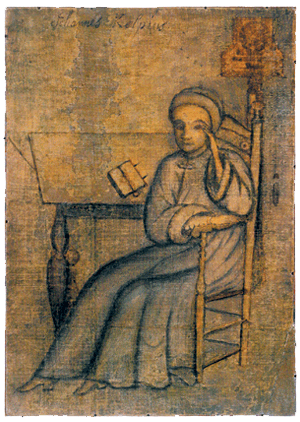
Johannes Kelpius - Not America's First Rosicrucian
A significant portion of my youth was spent in Philadelphia and I was immersed in the stories and legends of the area, even though many of my contemporaries paid little attention to them. The most fascinating of these were doubtlessly the stories I heard about the mad visionary monk or magician who lived alongside the Wissahickon Creek. The legends were fantastic, and the fact that they seemed to contradict themselves and left room for the suspicion that the truth was something other, did nothing to dampen my enthusiasm for the most outrageous of them.
In graduate school I did a little more digging and found many fascinating facts about the magician of the legends I heard as a child. Unfortunately, I have found that most adults are not as interested in finding the truth as I was. So, a recent visit by a friend which led me to take him to see the sites associated with the legends if not the facts, has led me to publicly right a few of the most commonly circulated errors.
![]() |
| Johannes Kelpius |
The small band of German pietists who settled in the Wissahickon Valley in 1694 were initially recruited by Johann Jacob Zimmerman, a former Lutheran minister and professor at Heidelberg University, disenfranchised by the church and dismissed from his academic post for his Pietist and millennialist beliefs. Religious wars devastated much of Europe throughout the seventeenth century, particularly Germany, then the Holy Roman Empire, during the Thirty Years War from 1618-1648.
![]() |
| Root Cellar not really associated with Kelpius |
During his life, Kelpius witnessed the growth of the religious and mystical movement called Pietism. It originally began as a faction of Lutheranism in Rome, but spread across Europe and grew particularly in Germany. Pietism rejected reliance on institutionalized religion and instead advocated deeper personal relationships with the spiritual world. Mystics especially found Pietism attractive because of its similarities to their own beliefs. Pietism's popularity spread quickly in Germany's intellectual community and shaped the academic environment that Kelpius studied in.
Although Kelpius guided the Pietists to America, he was not the group's original leader. Johannes Zimmermann, a noted mathematician and astronomer, took to mysticism and became convinced that Jesus Christ would descend from the heavens to begin the millennium in March of 1694. To prepare for the Second Coming, Zimmermann organized a group of forty devotees (including himself) to await the return of Christ in the New World. The work that Fabricus and Kelpius published impressed Zimmermann, and he sought out and recruited Kelpius as his Deputy Magister.
![]() |
| Wissahickon Monastery |
| Ephrata Cloister |
According to Philadelphia legend, they marched to Fairmount. For those of you unfamiliar with the historic names of Philadelphia geography, that is the location where several centuries later Rocky Balboa ran up the museum steps in the movie. where they lit fires and celebrated St. John's day.
![]() |
| Ephrata Song Book |
![]() |
| "Lady in the Wilderness" from Ephrata |
Beissel, went on to lead a group to found a similar Pietist community in Effrata, Pennsylvania in 1730. The community prospered while Beissel lived, but began to decline after his death. In 1814, the scant few remaining dwellers of Ephrata Cloister incorporated themselves as the Seventh Day German Baptist Church, a title which survived until 1934. With its future in limbo during the late 1920's, these few members recognized the end of their communal experiment but strongly disagreed on how to best dispose of the grounds, buildings, and artifacts which held considerable monetary and historical value. The arguments escalated into legal action against each other to such a degree that the courts revoked the incorporation of their charter and placed the property under receivership. The Pennsylvania Historical and Museum Commission assumed ownership of the grounds and buildings in 1941, with a program of research, interpretation, and careful restoration.
Nothing remains of the original Temple built by Kelpius and his followers, and while we know the general area where it was located, we do not know the exact location. The Monastery House most likely was built after Kelpius' death and is understood to have belonged to the group under Beissel's leadership which subsequently moved to the Cloisters in Ephrata, Pa. Of course, it might also have been used by the Dunkers, another Pennsylvania religious community which coexisted in the Wissahickon.
| Böhmeian Philosophical Illustration |
Kelpius was a follower of Böhmeianism We might today call him a Bohemian, as the modern term it is claimed has been influenced both by the term Böhmeianism and the region known as Bohemia. One of Boehme's most influential works was named Aurora. In that book, he defined seven major qualities, planets and humoral-elemental associations:
1. Dry - Saturn - melancholy, power of death;
2. Sweet - Jupiter - sanguine, gentle source of life;
3. Bitter - Mars - choleric, destructive source of life;
4. Fire - Sun/Moon - night/day; evil/good; sin/virtue; Moon, later = phlegmatic, watery;
5. Love - Venus - love of life, spiritual rebirth;
6. Sound - Mercury - keen spirit, illumination, expression;
7. Corpus - Earth - totality of forces awaiting rebirth.
In "De Tribus Principiis" or "On the Three Principles of Divine Being" Böhme subsumed the seven principles into the Trinity:
1. The "dark world" of the Father (Qualities 1-2-3);
2. The "light world" of the Holy Spirit (Qualities 5-6-7);
3. "This world" of Satan and Christ (Quality 4).
![]() |
| Grave of Conrad Beissel |
Subscribe to:
Posts (Atom)