Sunday, December 9, 2012

Johannes Kelpius - Not America's First Rosicrucian


A significant portion of my youth was spent in Philadelphia and I was immersed in the stories and legends of the area, even though many of my contemporaries paid little attention to them. The most fascinating of these were doubtlessly the stories I heard about the mad visionary monk or magician who lived alongside the Wissahickon Creek. The legends were fantastic, and the fact that they seemed to contradict themselves and left room for the suspicion that the truth was something other, did nothing to dampen my enthusiasm for the most outrageous of them.

In graduate school I did a little more digging and found many fascinating facts about the magician of the legends I heard as a child. Unfortunately, I have found that most adults are not as interested in finding the truth as I was. So, a recent visit by a friend which led me to take him to see the sites associated with the legends if not the facts, has led me to publicly right a few of the most commonly circulated errors.

Johannes Kelpius
The man I am referring to was a well educated German Pietist from what is now Switzerland. Actually, this man, most commonly known today as Johannes Kelpius, was born in Transylvania. He was a radical pietist. For those who wish to make the claim that he was America's first Rosicrucian, including AMORC, I am sorry to burst your bubble. Radical Pietists were not Rosicrucians. They certainly influenced what came to be known as Rosicrucianism, but they were no more Rosicrucians than ancient Jews were Christians because the Christian faith grew out of Judaism.

The small band of German pietists who settled in the Wissahickon Valley in 1694 were initially recruited by Johann Jacob Zimmerman, a former Lutheran minister and professor at Heidelberg University, disenfranchised by the church and dismissed from his academic post for his Pietist and millennialist beliefs. Religious wars devastated much of Europe throughout the seventeenth century, particularly Germany, then the Holy Roman Empire, during the Thirty Years War from 1618-1648.

Root Cellar not really associated with Kelpius
Johannes Kelpius, the man who lead this group, was born in Transylvania around 1667. Born to a Lutheran pastor, he developed an interest in theology at a young age. Kelpius excelled as a scholar and received a doctorate of philosophy and the liberal arts in Nuremburg in 1689, where he received a "thorough scientific and religious education." He became fluent in German, English, Latin, Hebrew, and Greek and used his knowledge for religious study and philosophy. The young man continued his studies and attended the University of Altdorf, where Dr. Johannes Fabricus closely nurtured his academic ambitions. Kelpius's prowess was such that, during his first year at Altdorf, he collaborated with his mentor to publish two books in 1690.

During his life, Kelpius witnessed the growth of the religious and mystical movement called Pietism. It originally began as a faction of Lutheranism in Rome, but spread across Europe and grew particularly in Germany. Pietism rejected reliance on institutionalized religion and instead advocated deeper personal relationships with the spiritual world. Mystics especially found Pietism attractive because of its similarities to their own beliefs. Pietism's popularity spread quickly in Germany's intellectual community and shaped the academic environment that Kelpius studied in.

Although Kelpius guided the Pietists to America, he was not the group's original leader. Johannes Zimmermann, a noted mathematician and astronomer, took to mysticism and became convinced that Jesus Christ would descend from the heavens to begin the millennium in March of 1694. To prepare for the Second Coming, Zimmermann organized a group of forty devotees (including himself) to await the return of Christ in the New World. The work that Fabricus and Kelpius published impressed Zimmermann, and he sought out and recruited Kelpius as his Deputy Magister.

Wissahickon Monastery
Under Zimmermann's direction, the group planned to settle in the woods surrounding the scarcely-settled Philadelphia. Pennsylvania proved an obvious choice with its reputation for religious tolerance and secluded environment where the Pietists could devote themselves to perfecting their souls uninterrupted. The wilderness, they concluded, provided them with the best environment to receive divine revelation in the manner that Moses and Elijah had. Furthermore, the port at Philadelphia was near the fortieth parallel. Mystics considered forty to be the perfect number, as Moses spent forty days on Mt. Sinai, and Christ wandered in the desert for 40 days, among other things.

Ephrata Cloister
In the summer of 1693, Zimmermann's group of forty Pietists rallied in Rotterdam, Holland, where they prepared for their journey. A Dutch Quaker, believed to be William Penn's Rotterdam agent, Benjamin Furley, took an interest in the group and their beliefs and provided them with 2,400 acres of land in the new world and £130 for their passage. Zimmermann's unexpected death later that year delayed the group's journey. Kelpius took Zimmermann's place as leader, and after restoring the group's membership to forty, Kelpius, "convinced by God, resolved upon going to America." On February 13, 1694, Kelpius boarded the English Sarah Maria and set sail. After many adventures, documented in Kelpius' Diary, which survives, the band arrived in Philadelphia.

According to Philadelphia legend, they marched to Fairmount. For those of you unfamiliar with the historic names of Philadelphia geography, that is the location where several centuries later Rocky Balboa ran up the museum steps in the movie. where they lit fires and celebrated St. John's day.

Ephrata Song Book
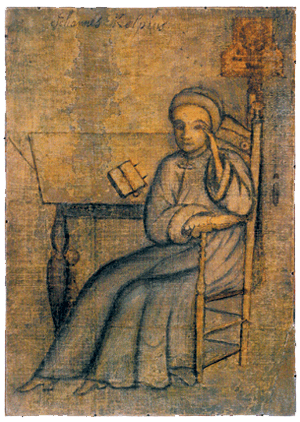
Legend also neglects to note that Kelpius and his group lived a life that was anything but removed from the German speaking community which occupied what is still called Germantown today. They taught children, grew a large botanical garden to help heal illnesses on the site where the Philadelphia Cricket Club Golf Course now exists. Legend also makes no mention of the fact that the monks, including Kelpius made a killing in local real estate, and that Kelpius went on to win a legal suit against him for real estate fraud. Kelpius and his followers performed what may have been the first chamber music concert in North America in Old Swede's Church, and the portrait of Kelpius by Christopher Witt, who founded Pennsylvania Hospital, is the oldest portrait in the United States.

"Lady in the Wilderness" from Ephrata
The Pietists, who believed literally that the return of Christ was imminent, were disappointed when the appointed date came and went, and many ended up leaving to live in Germantown. Kelpius stayed on with Conrad Mathai. When Kelpius died in 1708, having had to be removed to Germantown to convalesce, this left Mathai and six of the original 40 still living at the monastery. This was the group which met Conrad Beissel who arrived in 1720 to join the group which locals had nicknamed "The Woman in the Wilderness," after the imagery of the New Testament Book of Revelations.

Beissel, went on to lead a group to found a similar Pietist community in Effrata, Pennsylvania in 1730. The community prospered while Beissel lived, but began to decline after his death. In 1814, the scant few remaining dwellers of Ephrata Cloister incorporated themselves as the Seventh Day German Baptist Church, a title which survived until 1934. With its future in limbo during the late 1920's, these few members recognized the end of their communal experiment but strongly disagreed on how to best dispose of the grounds, buildings, and artifacts which held considerable monetary and historical value. The arguments escalated into legal action against each other to such a degree that the courts revoked the incorporation of their charter and placed the property under receivership. The Pennsylvania Historical and Museum Commission assumed ownership of the grounds and buildings in 1941, with a program of research, interpretation, and careful restoration.

Nothing remains of the original Temple built by Kelpius and his followers, and while we know the general area where it was located, we do not know the exact location. The Monastery House most likely was built after Kelpius' death and is understood to have belonged to the group under Beissel's leadership which subsequently moved to the Cloisters in Ephrata, Pa. Of course, it might also have been used by the Dunkers, another Pennsylvania religious community which coexisted in the Wissahickon.

Böhmeian Philosophical Illustration
What exactly did they believe and teach? They were first and foremost Lutherans. They rebelled against the rigidity of the Lutheranism of their day, but they were essentially Lutherans with a mystical worldview. This was the same forge out of which what we today call Rosicrucianism was born. There were certain minor similarities and parallels, but there were also significant differences between the two philosophies. Sorry AMORC, your impressive plaque at the site of the root cellar both you and local folklore incorrectly identify as The Hermit's Cave is incorrect on two points. The first is that this location was not used by Kelpius, although he may have walked close by where it today stands. The second is that Kelpius was not a Rosicrucian, nor would he have self-identified as one. It is even quite possible that he was not familiar with the term. It certainly is not mentioned in any of the brief works we have which can be identified as his work. So, while it pleases me to see that you have honored Philadelphia's favorite esoteric son, for some of us at least, accuracy matters. Had your memorial sign read "Kelpius was a Radical Pietist whose faith in many ways anticipated modern Rosicrucianism" it would not have as much dramatic impact in your favor, but it would have been a lot more historically accurate, and that would be welcome. Instead, setting themselves up as an authority, they have perpetrated the spread of misinformation. That is unfortunate.

Kelpius was a follower of Böhmeianism  We might today call him a Bohemian, as the modern term it is claimed has been influenced both by the term Böhmeianism and the region known as Bohemia. One of Boehme's most influential works was named Aurora. In that book, he defined seven major qualities, planets and humoral-elemental associations:

1. Dry - Saturn - melancholy, power of death;
2. Sweet - Jupiter - sanguine, gentle source of life;
3. Bitter - Mars - choleric, destructive source of life;
4. Fire - Sun/Moon - night/day; evil/good; sin/virtue; Moon, later = phlegmatic, watery;
5. Love - Venus - love of life, spiritual rebirth;
6. Sound - Mercury - keen spirit, illumination, expression;
7. Corpus - Earth - totality of forces awaiting rebirth.
In "De Tribus Principiis" or "On the Three Principles of Divine Being" Böhme subsumed the seven principles into the Trinity:
1. The "dark world" of the Father (Qualities 1-2-3);
2. The "light world" of the Holy Spirit (Qualities 5-6-7);
3. "This world" of Satan and Christ (Quality 4).  

Grave of Conrad Beissel
Böhmeianism does not describe the beliefs of any single religious group, rather, it is a more general description of Böhme's interpretation of Christianity. Böhme influenced many anti-authoritarian and Christian mystical movements, such as the Religious Society of Friends (Quakers), the Philadelphians,  the Gichtelians, the Society of the Woman in the Wilderness (Kelpius' group), the Ephrata Cloister, the Harmony Society, Martinism, and Christian theosophy. Böhme was also an important source of German Romantic philosophy, influencing Schelling. Richard Bucke, in his 1901 treatise Cosmic Consciousness, gave special attention to Böhme's spiritual enlightenment. Böhme is also an important influence on the ideas of the English Romantic poet, artist and mystic William Blake.

Saturday, December 8, 2012

Hedge Mason Award First Recipient

The first Annual Hedge Mason Award for Encouraging the Growth of Liberal Mixed Masonry 

The Hedge Mason has determined, after existing for a little over a year, that it is time to give recognition to those individuals who, intentionally or not, have aided the growth of Liberal Mixed and Adogmatic Freemasonry through their masonic work and life.

This year, although there are many hard working members of Liberal Freemasonry who deserve recognition, the individual who has through his actions and masonic life, has done more to highlight the value of and need for Liberal Mixed Masonry in North America in particular has to be, without question,

The Venerable Grand Master Jorge Aladro of the Grand Lodge of Free and Accepted Masons of the State of Florida. 


As soon as the Hedge mason can design and execute an appropriate certificate, we will produce it and send it to Bro. Aladro. We wish to congratulate him on a job well done. His efforts to violate the fundamental Landmarks which mainstream masons in Florida claim are the foundation of their organization, by instigating quite literally, a witch hunt, and forcing serious students of Freemasonry to resign from the Lodge deserves recognition. I am pleased to note that with opponents like this, who needs friends? Hats off to you Brother Aladro, and a hearty Huzzah, Huzzah, Huzzah, from all of us in the ranks of Liberal Freemasonry. 


The Creative Power of Dreams


International Association for
the Study of Dreams

New England, Regional Conference 

"The Creative Power of Dreams"
Saturday, January 12, 2013* Snow date: January 26, 20139:30 a.m - 4:30 p.m.
Regis College
Weston, Massachusetts
Contact: Curtiss Hoffman
For millennia, creative people in all cultures have relied upon their dreams for inspiration.  Come and celebrate the creative power of dreams at this one-day IASD regional conference!   Keynote speakers are Deirdre Barrett, the author of The Committee of Sleep, and Ernest Hartmann, the author of The Nature and Functions of Dreaming.  In addition, there will be a performance of excerpts from Curtiss Hoffman's Gilgamesh Cantata, based on dream texts from C.G. Jung's Red Book and using musical themes derived from his own dreams.  Additional speakers will present papers on various aspects of dreaming and creativity.
Regis College is located in Weston, Massachusetts, near the intersection of Routes I-90 (Massachusetts Turnpike) and I-95 (Route 128).  It is accessible by bus from the Riverside Green Line T station.  Buses run about every half hour to and from Riverside. 
Early Bird Registration before December 15th, 2012
Regular $68; Student/limited income $38
(After Dec. 15th - regular $78; student/limited income $38)
Registration includes morning hospitality (coffee/tea/pastries) and a buffet luncheon. We regret that we cannot guarantee lunches for registrations received after January 1, 2013. A more complete listing of speakers and topics & transportation information to reach Regis College will be made available in late October 2012.
All USA mail-in registrations must be postmarked by January 2th, 2013 Download and mail in your registration form and send a check made out toIASD-New England Regional for the full amount in USD to the:
IASD Office1672 University Avenue
Berkeley, CA 94703.
or pay online using our secure PayPal system.
Keynote Speakers:
Ernest Hartmann:  The Nature and Functions of Dreaming:   The Dream is the Beginning of a Work or Art.
Deirdre Barrett:   Dreams and Creative Problem Solving
Papers:
Jeffrey Armano:  Shamanic Dreams: The Power to Regenerate
Linda Yael Schiller:  Creativity, Kabbalah, and Dreams
Lesley Zaret: Dreams and the Body
Tzivia Gover:  Dreaming on the Page: The Intersections between Dreams and Writing
Laura Atkinson:  Focus on the Dream: Photographic Techniques to Connect with a Dream
Ryan Hurd:  It's Daemonic! Reclaiming Access to the Daemon-Muse in Sleep Paralysis Visions and Lucid Dreams
Beth Scanzani: Dreaming on Purpose:  Discovering a Path to Joy and Fulfillment...While You Sleep
Gloria Sturzenacker:  Tiuken, Jorbor, Beseta: A Long-Term Search for the Meaning of Three Unknown Dream Words
Special Presentations:
Curtiss Hoffman: The Gilgamesh Cantata:  A Dream-Based Creative Process
Beth Scanzani and Lesley Zaret:  Stories from the Night Shift (dream group)
For additional information, please contact Curtiss Hoffman
Here's the webpage where you can find the active links and the registration form:http://www.asdreams.org/regionals/2013newengland/


Friday, December 7, 2012

The Lausanne Congress: A brief Primer

I am posting this recorded history of the Lausanne Conference, recognizing that it may be a bit dry, and for those unfamiliar with any Brazilians, a bit difficult to follow. However, it provides some valuable information, albeit a bit conservative in its slant, on an important event in the history of the Scottish Rite in the world.

Since North Americans tend to be all but totally ignorant of this history, I figured it would not hurt to offer it here. It dealt with many things more important than the issue of the GAOTU, which is perhaps the only issue from its agenda of which North Americans are aware.

Whether it provides new information to you or not, and whether you agree with the perspective here, it's worth a listen. Learning more about any aspect of Masonry will only make for a better masonic body.

The speaker is William Almeida DeCarvalho, a Past Grand Master of the Grand Orient of Brazil, and a member of their research lodge.


The Lausanne Congress from WEOFM on Vimeo.

International Celtic Congress 2013

An Guntelles Keltek - Kernow 2013
The INTERNATIONAL CELTIC CONGRESS 2013
An Chomhdháil Cheilteach Idirnaisiúnta 2013
Aibreán 1-6 2013 

Bodmin, An Chorn
Lanhydrock Hotel and Golf Club, near Bodmin

From Monday 1st - Saturday 6th APRIL 2013.


THEME: YOUTH AND THE FUTURE OF CELTIC CULTURE 
---------- 
PRICE FOR WHOLE WEEK:
£340 per person sharing
£490 per person in single occupancy
This includes accommodation, concerts and trips out visiting historical venues in the locality.
Deposit of 20% to be made by December 31st 2012. Balance by March 1st 2013 in Pounds Sterling

For more details or to be kept up-to-date with information please contact:
Kernow Secretary: (Mrs) Denise Chubb, Gordon Villa, Sunnyvale Road, Portreath, Redruth, TR16 4NE. 
Telephone: +44 1209 842394 or e-mail denise@spyrys.org
Or:
Kernow Chairman: Tony Piper Telephone: +44 1209 711509 or e-mail jamesapiper@btinternet.com
Kernow Treasurer: Jerry Rogers jerryrogers@sgrconsultancy.co.uk


Tuesday, December 4, 2012

Landmarks and Exlax Freemasonry

I usually try to avoid severe controversy, but this is too much even for me. It is a sad commentary that we are into the teens of a new century and the Masonic Landmarks, those vague and fluctuating set of general characteristics attributed to Freemasonry continue to be used more for abuse than for whatever valid purpose they may once have held.

Of course, I am speaking of the current Witch hunt being carried out in Florida by the Grand Master of the mainstream Grand Lodge there. No, I'm not speaking metaphorically. GM Jorge Aladro, is acutally trying to purge witches and pagans from the Grand Lodge. Evidently, it is not enough to believe in deity for him, you have to conceive of it just as he does.


Come on now. In kindergarten the teacher taught us to play nice and not run with scissors. It's not that difficult. The idea, all too common in Christianity alas, that there is only one right and true way to reach God, truly is a dead end, socially. We live in a multi-cultural and multi-religious world. We have the right to demand a certain measure of civility, but in order to receive it we have to give as good as we wish to receive.

Teaching social science courses to undergraduates, I on occasion have had to explain to students enculturated into a religion that is overly addicted to proselytization that we cannot tell others that their beliefs are wrong if we wish to have a reasoned conversation with them. I also point out, as if it should need stating, that being the member of any religion means you are trying to approach the sacred and make room for it, as you understand it, in your life. No exceptions. That speaks to one's worthiness of being a mason, regardless of which religion you espouse.

Evidently, the Grand Master of Florida needs a refresher course in Comparative Religion. Better yet, he may need to actually read something about Freemasonry. I say this because he is making the same old sad mistake of trying to use "Landmarks," whatever they are, to defend his personal brand of narrow minded intolerance. Yes, I did say "Landmarks, whatever they are." Why? Because, As a Freemason with a brain, I find "Landmarks" at least as they are most commonly abused, to be an intolerable affront. They are almost never used in a positive way. Instead, in arguments that harken back to an inquisitional mindset, they are almost always used in a calculating way to say "I am a mason, and you are not." In the most respectfully masonic way possible, I say, "nonsense." Actually, I was thinking of a two syllable word incorporating the waste products of certain barnyard animals, but this is a civil forum. Adamantly,  I insist that there's no way to be polite in the face of hypocracy and bigotry.

So, let's look at that issue of Landmarks for a moment. Apart from the fact that as an academic I am well aware that Anderson's great works were largely created out of broadcloth, yes, I mean Anderson wrote fiction, and not an especially creative or credible fiction at that. Anyone who knows how to apply critical judgement to historical claims can see the holes in his story from at least 10 miles away. But let's not act surprised and pious here. It's not as if I'm the first to have pointed any of this out.


Robert Freke Gould (1836-1915) wrote that

"Of the ancient landmarks it has been observed with more or less foundation of truth: 'Nobody knows what they comprise or omit as they are of no earthly authority, because everything is a landmark when an opponent desires to silence you; but nothing is a landmark that stands in his own way."

Nigel Gallimore, writing in the Workman, Voll III, No. 10 in March, 2012, notes that not only has the UGLE not defined any landmarks beyond a belief in a supreme deity, but that they were unable or unwilling to define even what that one landmark meant. He notes that even as far back as 1717, that other fiction of Anderson's, no real consensus on landmarks could be found, leaving even this one unqualified.

This leaves us with a man who represents the "regular" Freemasons of Florida (I assume that means those freemasons who are not in the habit of buying Ducolax or Exlax) tripping over his own feet.

How does this rationally relate to the old claim of "making good men better." Well, in civil society, we tend to be tolerant of other people's religions, even if we find them problematic. In short, this flies in the face of all that Freemasonry CLAIMS it is about. Is there a  hidden reason why the Grand Master wants to defame Freemasonry? Why is he trying to hammer a few more nails into the already well fastened coffin in which Grand Lodges such as Georgia, and Arkansas have worked so hard to entomb Albert Pike? 


Well, as I noted at The Bee Hive already, I am certain that there are a number of Liberal and Adogmatic Obediences in the US who would be pleased to welcome any and all Neopagans, Wiccans, and uncertains to join. Feel free to contact me here. I'll be glad to help you find a new home. We even welcome women! Yes, that means we live in the 21st Century, not the early 19th Century, and in the United States, not Stalinist Russia. Come on boys, you're embarrassing us all! Can't you at least pretend to be adults?

ADDENDUM:

I have appended a few more thoughts that I feel are important. Having read Brother Corey Bryson's explanation of events, and not wishing to extend this subject to more than one blog entry, if possible, I felt there was something more that I should say. I need to respond to Brother Bryson's remarks on several points. The first thing I wish to note, is that Jorge Aladro's decision not withstanding, I consider Corey Bryson a masonic brother in good standing and am prepared to act to assure it. Should he not choose to accept the invitation of our brothers in PHA which I noted was extended elsewhere, I am prepared to assist him within the realm of Liberal, Adogmatic freemasonry within the USA. Some of us not only welcome Pagans and Wiccans, but understand the historical connections between Freemasonry and the modern Wicca and Neopagan movements.

That subject dispensed with, I think it needs to be noted that this man and his views do not represent what Freemasonry is. Certain obediences have been overtaken by people who have not one iota of understanding of what Freemasonry is supposed to be. Our unfortunately benighted Bro. Aladro is an example of this sort of "buddy club" mason. While I am more than happy to expound on the benefits and advantages of Liberal and Adogmatic Freemasonry, I would be remiss if I did not state publicly that there are good, sincere, and worthy members of the so-called "regular" branches of Freemasonry as well.

It is my most profound wish Brother Corey, that you do not allow this sad and despicable behavior on the part of one man who's judgement and masonic character is open to question cause you to feel bitter toward Freemasonry, or to reject it. There are obediences which are not infected by this sort of narrow-minded bias. The door is open to a few of them should you choose to knock. That offer will remain open.


Monday, December 3, 2012

Dreaming the Eye in the Triangle


The world of dreams is where we are most alive and come closest to realizing our true potential. If you are a complete materialist, I've already lost you. However, if you have ever been curious about what lies beyond the Gates of Horn and Ivory, then perhaps you remember some special dream which seemed more vibrant or more exciting than the waking world. Maybe you have even explored methods for remembering your dreams or gone even further, seeking techniques to explore various aspects of your dream existence. Stay with me here. Dreams are recognized not merely by visionaries and artists as being important but also by psychologists and even biologists. Without dreams we would not maintain good mental or physical health. So, even though science does not understand as much about dreams as artists, musicians, and mystics do, they know we cannot live healthy lives without plenty of them. 

My Early Experiences of the Dreamscape

I first became interested in dreams beyond the casual curiosity that children may have, when during the winter of my tenth year I came down with a severe case of flu. I must have been running a pretty good temperature because I found one night I was catapulted into an extremely vivid, colorful and dramatic dream. Not only that, but the following night, the dream picked up where it had left off. This went on for three or four days. Then my dreams returned more or less to normal. I was obsessed with finding out how to recapture this intense form of dreaming. I didn't have a great deal of immediate success, but this was when I first began committing my dreams to the page. Having already been keeping a diary, this was not perhaps such a giant leap. It was however an important one. I have kept written records of my dreams almost without interruption since, although over the years, unfortunately, a few volumes have been lost.


Techniques of the Dreamer

There are many techniques which can be utilized to benefit from dreaming. Learning to value dreams is the first step. You will not remember your dreams if you do not value them. If you do not already have strong dream recall, start talking to yourself about your dreams. You might want to do this silently to avoid losing friends and alienating family and coworkers. However, setting up a desire and expectation that you will remember your dreams will aid immensely in developing recall. Biological science already assures us that the average adult human dreams about 5 times per night. So, the issue is developing recall.

There are a few simple steps to doing this.
1. State or write your intention to recall your dreams
2. Act to confirm that intention. By this I mean, set out materials to write your recalled dreams down; write them out as soon as you awake whether in the middle of the night or in the morning.
3. Repeat 1 and 2 every night.

You may not recall them at first, but if you persist, you will succeed.

Then, find books and other material on dreams. There's a wealth of material out there. Look and explore as many of them as you are drawn to. Avoid formulaic books; that means dream dictionaries. Every dreamer has his or her own language of dreams; you need to learn your own. 
How can you do this? If you wish to achieve true dreaming,  you need to keep or recapture your pure, calm, imaginative spirit

The Dream Lodge

How does any of this relate to Freemasonry? Well, Freemasonry, whether the UGLE likes it or not, has long been associated with Hermetic science. Hermeticism is concerned with gaining a profound vision of the creative force behind existence.  What Hermeticism teaches is that the consciousness in you which sees and hears is the eye of god; your mind is god. If you can understand that, then the light will be yours.

By this, we do not mean that the conscious self is God, but rather that God dwells within us and is directly, at least potentially available to us through our minds. This is the point of Hermetic study, and indeed, even of the major Christian mystics over the centuries.

Don't freak out. We're going to step back a bit from that precipice. What can you do that is practical and doesn't deconstruct your early 21st Century materialist brain beyond repair? OK, here's something a lot more conservative. You may have been exploring Masonic symbolism. You may even have ignored your Grand Lodge's admonitions and have read such heretical tomes as those written by McNulty, in the process breaking the most important landmark of them all, "Thou shalt not read anything intelligent about Freemasonry."  So, we're going to discuss how to create a dream in which you explore the symbols of Freemasonry.

Incubating the Masonic Dream

For this exercise, imagine your lodge. Attempt to visualize all the details from the doors to the four corners, to the tiled floor. Imagine the furniture, the lights, and the entire ambiance of your lodge. If you have an ideal or preferred lodge to your actual one, you may choose to visualize that ideal lodge. If for example, you love the appearance of Kilwinning No. 0, then imagine Kilwinning. Bring to mind the symbols you wish to explore. Pick only one or two. Spend some time examining a wide range of images depicting these specific symbols. Make those images as diverse as you can find.


Sit on the side of your bed and quiet you body and mind. Next, hold your images in mind for a few moments, then lie down. As you prepare for sleep, gently ask yourself to have and clearly remember a dream that explores both the images and meanings of these symbols. As you drift off to sleep, hold your intention, confident that the dream you remember will bring your symbols to life in unexpected and wonderful ways. If other thoughts distract you, return to your incubation focus.

When you wake, whether in the morning or at any point during the night, write down any dreams or recollections that you have. Do not attempt to analyze anything, just write out  whatever you remember.  Even if you don't remember any dream at first,  persevere.  You have begun a journey and if you keep on you will begin to recall a great deal. Such an exercise can make the meaning and importance of dreams and masonic symbols far more vibrant than any other approach. Take notes and keep going. This can be the beginning of an amazing adventure; one which may last a lifetime.